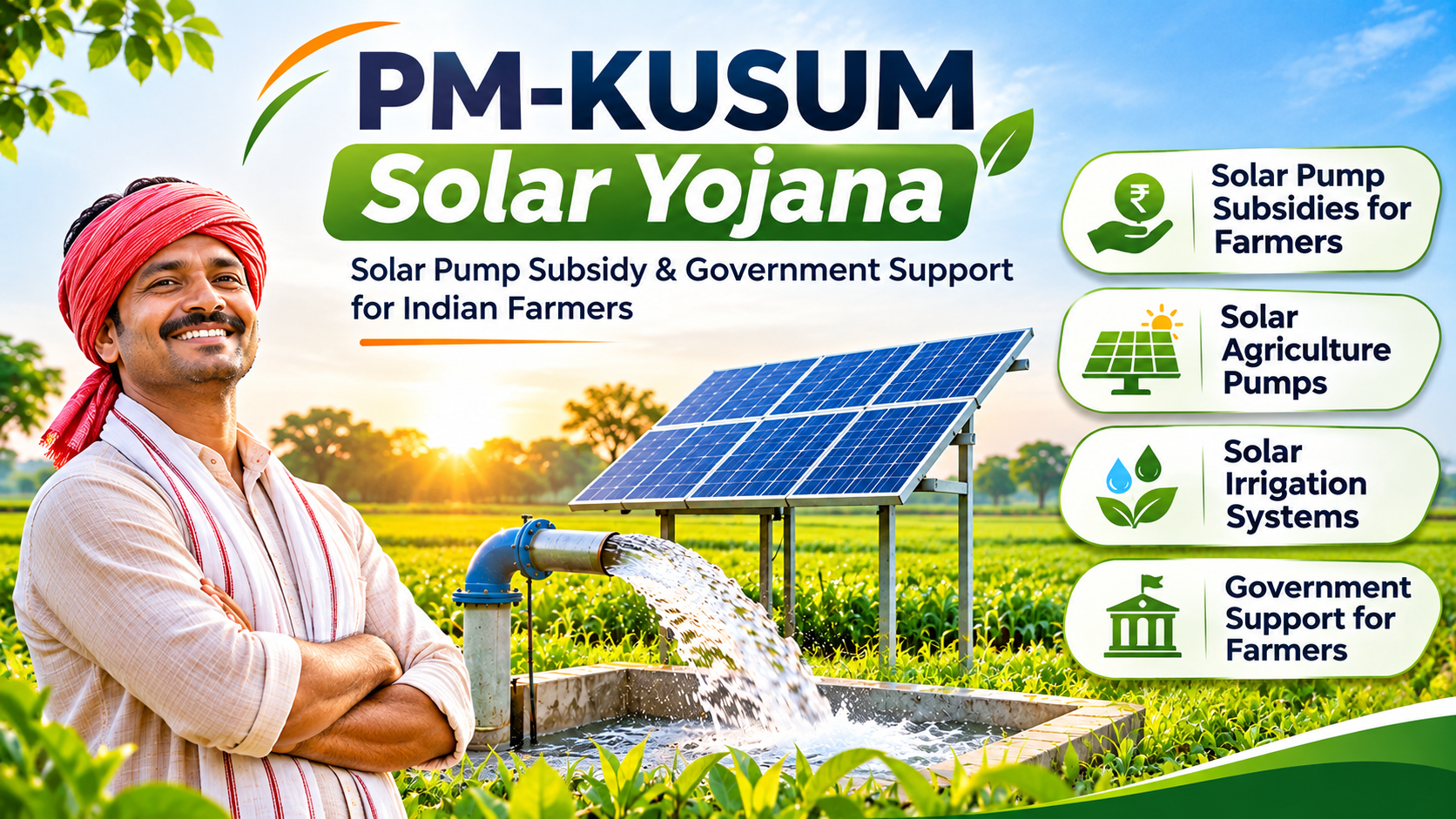
For Indian farmers, reliable and affordable irrigation is essential for productive agriculture. Traditional diesel and grid-powered pumps can add significantly to farming costs, especially when fuel and electricity expenses rise. To encourage the adoption of renewable energy in agriculture, the Government of India introduced the Pradhan Mantri Kisan Urja Suraksha evam Utthaan Mahabhiyan (PM-KUSUM).
The PM-KUSUM scheme aims to reduce dependence on diesel in agriculture, promote solar energy, support solar-powered irrigation, and create additional opportunities for farmers to generate income from renewable energy. The scheme includes support for standalone solar agriculture pumps, solarisation of existing agricultural pumps, and decentralised renewable-energy projects.
What Is PM-KUSUM Solar Yojana?
PM-KUSUM is a government initiative administered through the Ministry of New and Renewable Energy (MNRE) and implemented through designated state agencies.
The scheme focuses on three major areas:
- Component A: Development of decentralised grid-connected renewable energy power plants.
- Component B: Installation of standalone solar agriculture pumps.
- Component C: Solarisation of existing grid-connected agricultural pumps, including feeder-level solarisation.
The official PM-KUSUM portal states that the scheme is designed for the de-dieselisation of the farm sector and enhancement of farmers’ income.
How Does PM-KUSUM Help Farmers?
Solar energy can provide farmers with a cleaner alternative for meeting agricultural energy requirements. Solar pumps can use sunlight to power water pumping systems, making them particularly useful in areas where farmers depend heavily on diesel or where reliable electricity supply can be challenging.
The major potential benefits include:
1. Solar Pump Subsidy Support
Under PM-KUSUM, government financial assistance is available for eligible solar agriculture pumps under applicable components.
The official national portal currently states that central government subsidy can be up to 30% or 50% of the total cost, depending on the applicable category and component. State government support and the farmer’s contribution can vary according to the state-level implementation structure.
Therefore, farmers should always check the latest subsidy structure, eligibility conditions and contribution amount announced by their respective state implementing agency.
2. Solar Agriculture Pumps
A solar agriculture pump uses solar PV panels to generate electricity for operating an agricultural water pump.
Instead of relying entirely on diesel or conventional electricity, farmers can use solar energy for irrigation during suitable daylight conditions.
Under Component B, PM-KUSUM provides for standalone solar agriculture pumps. The comprehensive 2024 guidelines provide for the installation of 14 lakh standalone solar agriculture pumps under Component B.
This makes solar pumping an important part of India’s broader transition toward renewable-energy-based agriculture.
3. Solar Irrigation Systems
Irrigation is one of the most important applications of solar energy in agriculture.
A solar irrigation system generally consists of:
- Solar PV panels
- Solar pump
- Pump controller
- Mounting structure
- Water source
- Irrigation network
Depending on the agricultural requirement, solar pumping systems can support different irrigation applications.
For farmers, the biggest advantage is the ability to use sunlight as an energy source instead of depending entirely on diesel fuel for pumping water.
4. Solarisation of Existing Agricultural Pumps
PM-KUSUM is not limited to installing new standalone solar pumps.
Component C focuses on the solarisation of existing grid-connected agricultural pumps. The scheme also provides for feeder-level solarisation.
The 2024 comprehensive guidelines set a target of solarising 35 lakh grid-connected agricultural pumps, including feeder-level solarisation.
This approach can help integrate renewable energy into existing agricultural electricity infrastructure.
5. Opportunity to Generate Additional Income
PM-KUSUM also goes beyond agricultural irrigation.
Under Component A, farmers and other eligible landowners can participate in decentralised grid-connected renewable-energy projects. The official PM-KUSUM portal states that grid-connected solar power plants of up to 2 MW can be installed on suitable barren or fallow land, with electricity sold to the local DISCOM at a tariff determined by the state regulator.
This creates the possibility of turning suitable unused agricultural land into an additional renewable-energy asset, subject to the applicable state rules and project requirements.
PM-KUSUM Components Explained
Component | Main Purpose | Benefit |
Component A | Grid-connected renewable energy plants | Opportunity for renewable-energy generation and potential income |
Component B | Standalone solar agriculture pumps | Solar-powered irrigation without relying entirely on diesel |
Component C – Individual Pump Solarisation | Solarisation of existing grid-connected agricultural pumps | Renewable energy integration with existing pumps |
Component C – Feeder Level Solarisation | Solarisation of agricultural feeders | Supports renewable-energy-based agricultural power supply |
Who Can Benefit From PM-KUSUM?
Eligibility and application procedures are determined through the applicable state implementing agencies and scheme guidelines.
Depending on the component, potential beneficiaries can include:
- Individual farmers
- Groups of farmers
- Farmer Producer Organisations (FPOs)
- Cooperatives
- Panchayats
- Water User Associations
- Other eligible entities
However, eligibility can differ between components and states. Farmers should therefore verify the current requirements through the official PM-KUSUM portal or their state-designated implementing agency.
How Does the PM-KUSUM Subsidy Work?
One of the most important things farmers should understand is that PM-KUSUM does not have one identical subsidy amount for every farmer across India.
The financial structure depends on factors such as:
- PM-KUSUM component
- State or Union Territory
- Pump capacity
- Applicable central financial assistance
- State government contribution
- Farmer contribution
- Financing arrangements
- Current state-level implementation guidelines
Under Components B and C, the farmer generally pays the balance amount after applicable government support. The PM-KUSUM FAQ also notes that financing can be available for the beneficiary’s share through eligible lending arrangements.
What Are the Benefits of Solar Pumps for Farmers?
Lower Dependence on Diesel
Solar pumping can reduce dependence on diesel-powered agricultural pumps. This can be particularly useful for farmers who regularly incur fuel expenses for irrigation.
Renewable Energy for Irrigation
Solar pumps use sunlight as their energy source, providing farmers with a renewable option for agricultural water pumping.
Potential Reduction in Operating Costs
Once installed, solar pumps can reduce the recurring fuel-related expenses associated with conventional diesel pumping. Actual savings depend on pump capacity, water requirements, usage patterns and system performance.
Cleaner Agriculture
Replacing or reducing diesel-based pumping can contribute to lower fuel consumption and support India’s broader renewable-energy objectives.
Long-Term Energy Solution
A properly installed and maintained solar pumping system can provide agricultural energy for years, subject to equipment quality, maintenance and operating conditions.
What Documents May Be Required?
The exact document requirements depend on the state and implementing agency. Farmers may commonly be asked to provide documents such as:
- Aadhaar or other identity proof
- Land ownership or land-use documents
- Address/residence proof
- Bank account details
- Agricultural electricity connection details, where applicable
- Passport-size photographs
- Other documents specified by the state implementing agency
Farmers should check the latest official application requirements before submitting an application.
How to Apply for PM-KUSUM?
The application process is handled through the designated implementing agencies of the respective states.
A typical process may involve:
Step 1: Check whether PM-KUSUM applications are open in your state.
Step 2: Identify the applicable component, such as a standalone solar pump or solarisation of an existing agricultural pump.
Step 3: Review eligibility requirements and the applicable farmer contribution.
Step 4: Submit the required documents through the officially designated channel.
Step 5: The implementing agency may conduct document verification and, where applicable, a site survey.
Step 6: After approval and other required formalities, the authorised vendor can proceed with installation.
The PM-KUSUM FAQ states that state implementing agencies and MNRE-empanelled vendors are responsible for installation under applicable pump components.
Important: Beware of Fake PM-KUSUM Websites
Farmers should be particularly careful while searching for PM-KUSUM applications online.
The official PM-KUSUM portal has warned farmers about fraudulent websites and mobile applications that claim to offer PM-KUSUM registration and ask applicants to pay registration fees or pump costs online.
Before making any payment or sharing personal information, farmers should verify the information through the official PM-KUSUM portal, MNRE, or the designated state implementing agency.
PM-KUSUM and the Future of Solar Agriculture
India’s agricultural sector is increasingly looking toward renewable energy to address rising energy requirements and improve the sustainability of farming.
PM-KUSUM brings together several important ideas: solar power generation, agricultural irrigation, pump solarisation and potential additional income from renewable-energy projects.
With the expansion of solar infrastructure, farmers can increasingly become not only consumers of energy but also participants in India’s renewable-energy transition.
Conclusion
The PM-KUSUM Solar Yojana is an important government initiative for promoting solar energy in agriculture. Through support for standalone solar pumps, solarisation of existing agricultural pumps and decentralised renewable-energy projects, the scheme aims to reduce diesel dependence and encourage cleaner energy use in the farming sector.
For farmers considering a solar irrigation system, the most important step is to understand the applicable PM-KUSUM component, state subsidy structure, eligibility criteria and farmer contribution before applying.
Solar-powered agriculture can play an important role in building a more energy-efficient and sustainable farming ecosystem in India.
SaurSetu aims to help farmers, businesses and stakeholders better understand India’s growing solar-energy ecosystem and the opportunities created by government renewable-energy initiatives.