Electricity bills are becoming a major household expense, and many Indian homeowners are looking for ways to reduce their monthly electricity costs. Rooftop solar is one option that allows households to generate electricity using sunlight and reduce their dependence on conventional power.
Among the available residential solar capacities, a 3kW solar system is a popular choice for small and medium-sized households. It can generate approximately 12–15 units of electricity per day under suitable conditions, making it useful for homes with regular electricity consumption.
But how much does a 3kW solar system actually cost? How much government subsidy can you receive? How many appliances can it operate, and how long will it take to recover your investment?
In this guide, we explain the 3kW solar panel price in India in 2026, installation expenses, government subsidies, electricity generation, monthly savings and other important factors to consider before purchasing a rooftop solar system.
3kW Solar System Price in India: Quick Overview
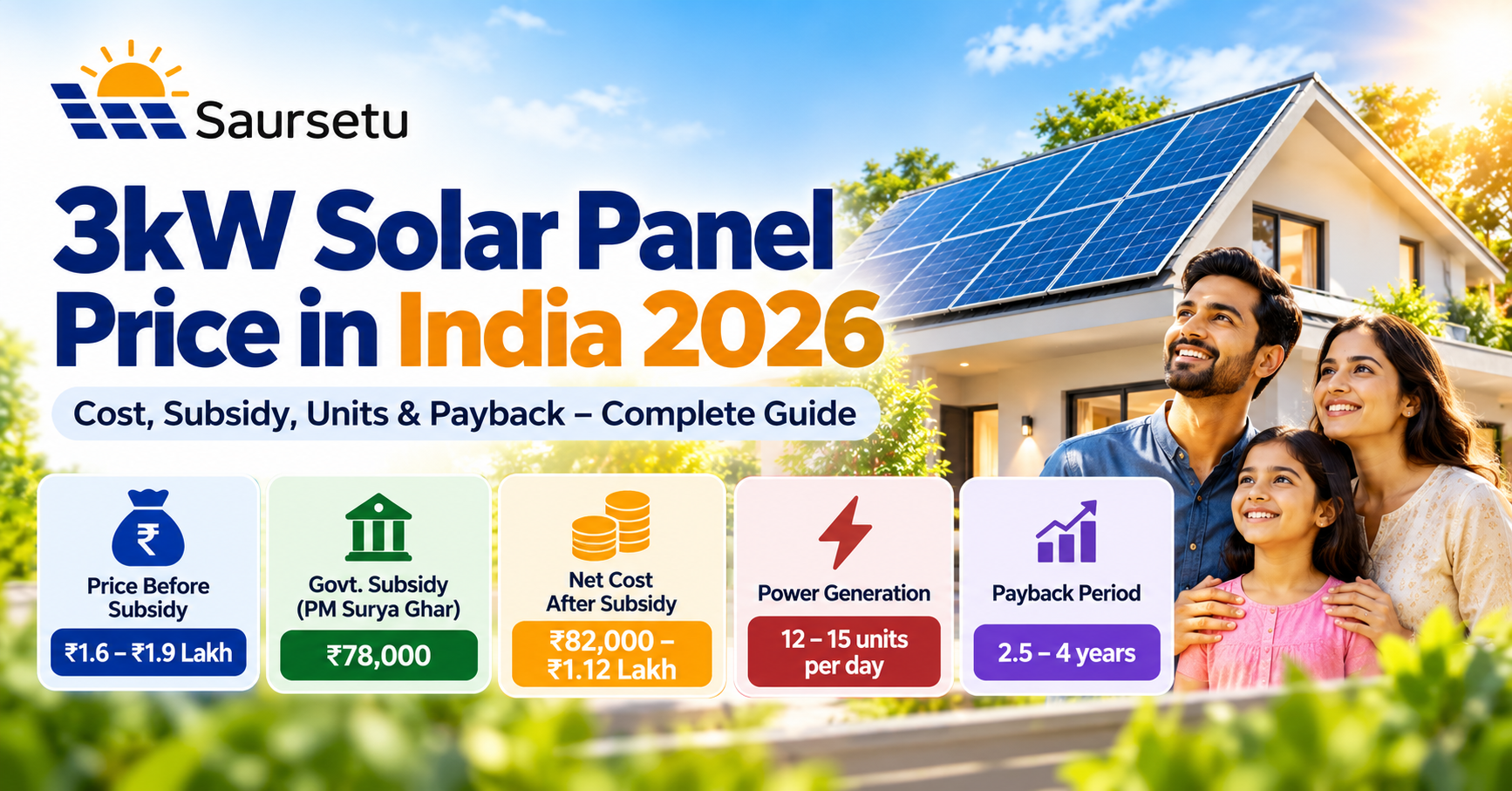
The estimated price of a 3kW on-grid solar system in India ranges from ₹1.60 lakh to ₹1.90 lakh before government subsidy.
Under the PM Surya Ghar Muft Bijli Yojana, eligible residential consumers can receive central financial assistance of up to ₹78,000 for a 3kW rooftop solar installation.
Here is a quick breakdown:
Particulars | Estimated Details |
Solar system capacity | 3kW |
Price before subsidy | ₹1.60–₹1.90 lakh |
Government subsidy | Up to ₹78,000 |
Estimated cost after subsidy | ₹82,000–₹1.12 lakh |
Daily electricity generation | 12–15 units |
Monthly electricity generation | 360–450 units |
Estimated monthly savings | ₹2,500–₹3,500 |
Expected payback period | 2.5–4 years |
Solar panel lifespan | 25–30 years |
Note: These are indicative estimates. Actual installation costs and electricity savings depend on location, equipment selection, electricity tariffs, roof conditions and system performance.
What Is a 3kW Solar System?
A 3kW solar system is a rooftop electricity generation setup with a total installed capacity of 3 kilowatts.
It uses solar panels to capture sunlight and convert it into direct current (DC) electricity. An inverter then converts this electricity into alternating current (AC), which can be used by household electrical appliances.
A typical residential 3kW solar installation includes:
- Solar photovoltaic (PV) modules
- Solar inverter
- Mounting structure
- DC and AC cables
- Distribution boxes
- Surge protection devices
- Earthing and safety equipment
- Net meter, where applicable
The actual number of panels depends on the wattage of the selected modules.
Is a 3kW Solar System Suitable for Your Home?
A 3kW rooftop solar system can be a suitable option for households consuming approximately 300–450 units of electricity per month.
It can support the electricity requirements of many 2BHK and 3BHK homes, depending on appliance usage and consumption patterns.
Consider a 3kW system if your household regularly uses:
- Ceiling fans and LED lights
- Refrigerators
- Television sets
- Washing machines
- Computers and laptops
- One inverter air conditioner for limited daytime use
However, the ideal solar capacity depends on your actual electricity consumption.
For example:
- Homes consuming below 200 units monthly may consider a smaller system.
- Homes consuming around 300–450 units may consider a 3kW system.
- Homes with multiple air conditioners or higher electricity requirements may need a 4kW or 5kW system.
Before selecting a capacity, check your previous electricity bills and discuss your requirements with a qualified solar installer.
How Many Solar Panels Are Required for a 3kW Solar System?
The number of solar panels required depends on the wattage of each module.
Higher-wattage panels can achieve the required system capacity using fewer modules, which can be useful when rooftop space is limited.
Here is an approximate comparison:
Solar Panel Wattage | Number of Panels | Total Capacity |
400 Wp | 8 | 3.2kW |
550 Wp | 6 | 3.3kW |
610 Wp | 5 | 3.05kW |
Modern N-Type TOPCon solar panels offer high module efficiency and can help maximise electricity generation from limited rooftop space.
For a 3kW installation, approximately 180–250 square feet of panel area may be required, depending on module dimensions and arrangement. Additional space should be considered for maintenance access and walkways.
For subsidy eligibility, homeowners should check the applicable DCR and ALMM requirements before purchasing solar modules.
3kW Solar Panel Price in India in 2026
The total cost of a 3kW solar installation depends on the type of system, solar panel technology, inverter, mounting structure and installation requirements.
Generally, residential solar systems are available in three configurations: on-grid, off-grid and hybrid.
1. 3kW On-Grid Solar System Price
An on-grid solar system operates in connection with the electricity distribution network.
It allows homeowners to use solar-generated electricity and export surplus electricity to the grid through an approved net-metering arrangement.
Estimated cost: ₹1.60 lakh–₹1.90 lakh before subsidy.
This option is suitable for homes with reliable grid connectivity.
2. 3kW Hybrid Solar System Price
A hybrid solar system combines solar generation with battery storage capabilities.
It can provide backup electricity during power outages when configured with suitable batteries and backup circuits.
Estimated cost: ₹2.10 lakh–₹2.30 lakh.
The applicable subsidy treatment and eligible system components should be confirmed with the authorised vendor.
3. 3kW Off-Grid Solar System Price
An off-grid solar system operates independently of the electricity grid and generally requires battery storage.
It can be considered for remote locations where grid electricity is unavailable or unreliable.
Estimated cost: ₹2.40 lakh–₹2.60 lakh.
Off-grid systems are not eligible for the central residential PM Surya Ghar subsidy described in this guide.
Price Comparison
System Type | Estimated Price | Subsidy |
On-grid | ₹1.60–₹1.90 lakh | Up to ₹78,000 |
Hybrid | ₹2.10–₹2.30 lakh | Subject to applicable eligibility |
Off-grid | ₹2.40–₹2.60 lakh | Not eligible |
The final quotation may vary depending on the equipment brand, battery capacity, rooftop design and local installation charges.
3kW Solar System Price in Different Indian States
Solar installation costs are not identical across India. Transportation, labour expenses, local market conditions and DISCOM-related requirements can influence the final quotation.
The following table provides indicative state-wise estimates.
State | Price Before Subsidy | Estimated Cost After Subsidy |
Gujarat | ₹1.60–₹1.75 lakh | ₹82,000–₹97,000 |
Rajasthan | ₹1.60–₹1.80 lakh | ₹82,000–₹1.02 lakh |
Maharashtra | ₹1.70–₹1.90 lakh | ₹92,000–₹1.12 lakh |
Karnataka | ₹1.65–₹1.85 lakh | ₹87,000–₹1.07 lakh |
Tamil Nadu | ₹1.65–₹1.85 lakh | ₹87,000–₹1.07 lakh |
Uttar Pradesh | ₹1.70–₹1.90 lakh | ₹92,000–₹1.12 lakh |
Delhi NCR | ₹1.75–₹1.90 lakh | ₹97,000–₹1.12 lakh |
These figures are indicative estimates rather than fixed government-approved installation prices.
Homeowners should obtain quotations from authorised vendors in their respective locations before making a purchase decision.
Complete Cost Breakdown of a 3kW Solar Installation
Understanding the individual components of a solar installation helps homeowners compare quotations and identify unnecessary expenses.
Here is an estimated component-wise breakdown:
Component | Estimated Cost |
DCR Solar Panels | ₹90,000–₹1,05,000 |
3kW On-Grid Inverter | ₹25,000–₹32,000 |
Mounting Structure | ₹15,000–₹20,000 |
Cables and Electrical Protection | ₹12,000–₹15,000 |
Installation and Labour | ₹12,000–₹15,000 |
Net Metering and Documentation | ₹4,000–₹6,000 |
Estimated Total | ₹1.58–₹1.93 lakh |
Why Does Each Component Matter?
Solar Panels: These modules convert sunlight into electricity. Their efficiency, technology and manufacturing quality influence overall system performance.
Solar Inverter: The inverter converts the DC electricity produced by solar panels into AC electricity suitable for household use.
Mounting Structure: It holds the solar modules securely and positions them at an appropriate angle for sunlight exposure.
Electrical Protection: Components such as ACDB, DCDB, surge protection devices and earthing help improve electrical safety.
Installation: Professional installation ensures proper wiring, structural support, system configuration and testing.
A detailed quotation should clearly mention the brand, specifications, warranty and quantity of every major component.
PM Surya Ghar Subsidy for a 3kW Solar System
The PM Surya Ghar: Muft Bijli Yojana is a central government initiative designed to encourage residential rooftop solar adoption in India.
Under this scheme, eligible residential consumers can receive financial assistance for installing rooftop solar systems through the approved process.
For a 3kW residential system, the central subsidy calculation is:
Solar Capacity | Subsidy Rate | Subsidy Amount |
First 1kW | ₹30,000 per kW | ₹30,000 |
Second 1kW | ₹30,000 per kW | ₹30,000 |
Third 1kW | ₹18,000 per kW | ₹18,000 |
Total | ₹78,000 |
Therefore, the maximum central subsidy for a standard residential 3kW installation is ₹78,000.
For systems larger than 3kW, the standard central subsidy remains capped at ₹78,000.
Special-category states and union territories have different applicable subsidy rates.
Who Can Apply for the PM Surya Ghar Subsidy?
The eligibility requirements include:
- The applicant must be an Indian citizen.
- The household must have a suitable rooftop for solar installation.
- A valid residential electricity connection is required.
- The applicant must meet the scheme’s previous-subsidy restrictions.
- The installation must follow the applicable technical and vendor requirements.
Subsidy eligibility also depends on the approved system configuration and applicable domestic-content requirements.
How to Apply for the Solar Subsidy?
Homeowners can follow these general steps:
- Visit the National Portal: Open the official PM Surya Ghar website and register using your electricity consumer details.
- Complete Registration: Enter your state, DISCOM and electricity consumer information.
- Choose an Authorised Vendor: Select an eligible vendor through the official portal.
- Complete the Installation: Get the rooftop solar system installed according to the approved technical requirements.
- Submit Installation Details: Upload the required information and complete the commissioning process.
- Complete DISCOM Verification: The installation must pass the applicable inspection and verification requirements.
- Receive the Subsidy: After successful verification and completion of the required formalities, the eligible subsidy is transferred to the registered bank account.
For the latest eligibility conditions and application process, visit the official PM Surya Ghar portal: https://pmsuryaghar.gov.in/
How Much Electricity Does a 3kW Solar System Generate Per Day?
Electricity generation is one of the most important factors when selecting a rooftop solar system.
A 3kW solar installation can generate approximately 12–15 units of electricity per day under favourable sunlight and installation conditions.
This translates into an estimated 360–450 units per month.
However, actual generation depends on:
- Sunlight availability
- Weather conditions
- Panel orientation and tilt
- Rooftop shading
- Module efficiency
- Temperature
- System maintenance
Seasonal Electricity Generation
Solar generation changes throughout the year because sunlight intensity and daylight hours vary by season.
Season | Daily Generation | Monthly Generation |
Summer (March–June) | 14–16 units | 420–480 units |
Monsoon (July–September) | 9–12 units | 270–360 units |
Post-Monsoon (October–November) | 12–14 units | 360–420 units |
Winter (December–February) | 11–13 units | 330–390 units |
These are approximate generation estimates. Actual output depends on local weather and installation conditions.
Which Home Appliances Can a 3kW Solar System Run?
A 3kW solar system can support several common household appliances, provided the combined electrical load remains within the system’s operating capacity.
Here is an illustrative household electricity consumption table:
Appliance | Quantity | Approximate Daily Consumption |
LED Lights | 8–10 | 0.54–0.72 units |
Ceiling Fans | 4–5 | 2.4–3 units |
Refrigerator | 1 | 1–1.5 units |
Television | 1 | 0.5 units |
Washing Machine | 1 | 0.5 units |
1.5 Ton Inverter AC | 1 | 4.5–6 units |
Laptop and Router | 2–3 | 0.8–1.2 units |
Actual consumption varies by appliance efficiency, operating conditions and usage duration.
Can a 3kW Solar System Run a 1.5-Ton AC?
Yes, a 3kW solar system can support one 1.5-ton inverter AC during suitable daytime operating conditions.
However, the AC’s actual power consumption depends on its star rating, temperature settings, room insulation and operating conditions.
Other household appliances also consume electricity, so the total simultaneous load must be considered.
For households operating multiple ACs regularly, a higher-capacity solar installation may be more appropriate.
How Much Money Can You Save with a 3kW Solar System?
The financial benefit of rooftop solar depends largely on how much electricity your household consumes and the applicable electricity tariff.
A 3kW solar system generating approximately 4,800 units annually can provide substantial savings over time.
Here is an illustrative comparison:
Electricity Tariff | Estimated Annual Savings | Approximate Payback Period |
₹5 per unit | ₹24,000 | 3.4–4.7 years |
₹7 per unit | ₹33,600 | 2.4–3.3 years |
₹9 per unit | ₹43,200 | 1.9–2.6 years |
₹11 per unit | ₹52,800 | 1.6–2.1 years |
The calculations assume the estimated post-subsidy investment of ₹82,000–₹1.12 lakh.
Actual savings depend on self-consumption, net-metering arrangements, applicable electricity charges and the amount of electricity exported to the grid.
How Long Does It Take to Recover the Investment?
The payback period is the time required for accumulated electricity savings to recover the initial installation investment.
For a 3kW rooftop solar system, the estimated payback period is approximately 2.5–4 years under the assumptions used in this guide.
Solar panels generally have an expected service life of 25–30 years, although inverters may require replacement earlier.
Long-term financial calculations should also account for maintenance, equipment replacement and gradual panel degradation.
Factors That Influence the Price of a 3kW Solar System
Two homeowners purchasing the same solar capacity may receive different installation quotations.
This happens because the total cost depends on several technical and location-specific factors.
1. Solar Panel Technology
Solar panels are available in different technologies, including Mono-PERC and N-Type TOPCon.
N-Type TOPCon modules offer higher efficiency and can generate more electricity from a limited rooftop area.
2. DCR Solar Panels
Domestic Content Requirement (DCR) is an important consideration for residential installations seeking government subsidy benefits.
Homeowners should confirm that the selected modules meet the applicable domestic-content requirements.
3. Inverter Selection
An on-grid inverter generally costs less than a hybrid inverter with battery-support capabilities.
The inverter should be selected according to system capacity and household requirements.
4. Rooftop Structure
RCC rooftops generally require standard mounting arrangements. Tin roofs and sloped roofs may require customised mounting structures, increasing installation expenses.
5. Installation Location
Labour, transportation, local market conditions and DISCOM-related requirements can affect the final price.
6. ALMM Compliance
Homeowners should check the applicable Approved List of Models and Manufacturers (ALMM) requirements and verify module documentation before finalising the purchase.
What Happens to a 3kW Solar System During a Power Cut?
The behaviour of a solar system during a power outage depends on its configuration.
On-Grid Solar System
A standard on-grid solar system automatically shuts down during a grid failure because of anti-islanding protection.
This safety mechanism prevents electricity from being supplied to the grid when maintenance workers may be working on power lines.
Hybrid Solar System
A hybrid solar system with a suitable battery and backup configuration can supply electricity to selected household appliances during a power outage.
Off-Grid Solar System
An off-grid solar installation uses battery storage to provide electricity independently of the utility grid.
If your area experiences frequent power cuts, discuss hybrid or off-grid options with a qualified installer.
Can You Purchase a 3kW Solar System on EMI?
The initial installation cost may seem high for some households. Solar financing can make the investment more manageable by spreading payments over a longer period.
Under the PM Surya Ghar programme, eligible residential consumers may have access to rooftop solar financing options through participating banks.
Loan eligibility, interest rates, tenure and available amounts depend on the bank’s current policies.
Before choosing EMI financing, compare:
- Interest rate
- Loan processing charges
- Repayment period
- Monthly EMI
- Total interest payable
- Eligibility requirements
A suitable financing arrangement can make rooftop solar more accessible, but homeowners should compare the total loan cost with their expected electricity savings.
Why Choose Avaada DCR TOPCon Solar Modules?
Selecting the right solar modules is important for long-term rooftop solar performance.
Avaada Electro manufactures solar cells and modules, with a focus on N-Type TOPCon technology.
Its module offerings can be considered by homeowners and solar installers looking for domestic solar manufacturing and high-efficiency module options.
Key Features of Avaada Solar Modules
Feature | Details |
Manufacturer | Avaada Electro |
Technology | N-Type TOPCon |
Module Design | Bifacial glass-to-glass |
Module Efficiency | 23%+ (as stated in the product information) |
Domestic Manufacturing | Butibori, Maharashtra |
Certifications | ALMM, BIS, UL and IEC, as applicable |
Performance Warranty | Up to 30 years, depending on the product |
How Can TOPCon Technology Benefit Homeowners?
N-Type TOPCon technology is designed to improve solar module efficiency.
Some important advantages include:
- Higher power generation potential per unit of rooftop space.
- Better suitability for installations with limited available area.
- Advanced solar cell technology.
- Potential for improved long-term energy production.
For subsidy-oriented residential projects, buyers should verify the exact module model, current ALMM listing and applicable DCR documentation before purchasing.
To explore Avaada solar modules and find an authorised dealer, visit the official Avaada website.
Checklist Before Buying a 3kW Solar System
Before accepting a solar installation quotation, review the following points carefully.
- Confirm that the solar modules meet applicable DCR requirements.
- Verify the relevant ALMM listing.
- Check the vendor’s eligibility under the PM Surya Ghar programme.
- Confirm the panel manufacturer and module wattage.
- Check the inverter manufacturer and specifications.
- Review the mounting structure material and design.
- Ensure that electrical protection and earthing are included.
- Confirm net-metering and documentation charges.
- Understand the product and performance warranties.
- Ask about installation workmanship coverage.
- Check whether system monitoring is available.
- Compare quotations from multiple authorised vendors.
A detailed quotation helps you understand exactly what you are paying for and reduces the possibility of unexpected installation expenses.
How to Maintain Your 3kW Rooftop Solar System
Solar panels generally require limited maintenance because they do not contain moving parts.
However, regular cleaning and system inspections are important to maintain generation efficiency.
Here is a basic maintenance schedule:
Maintenance Activity | Recommended Frequency |
Solar panel cleaning | Every 2–4 weeks, depending on dust |
Inverter display inspection | Monthly |
Electrical wiring inspection | Every 6 months |
Solar generation monitoring | Monthly |
Professional maintenance | Annually |
Inverter replacement | As required, based on equipment life |
Dust, bird droppings and other debris can reduce the amount of sunlight reaching the solar cells.
Regular monitoring also helps identify unusual drops in electricity generation.
1kW vs 3kW vs 5kW Solar System: Which One Should You Choose?
Choosing the correct solar capacity is important because an undersized system may not meet your household requirements, while an oversized system may increase your initial investment.
Here is a general comparison:
Parameter | 1kW | 3kW | 5kW |
Suitable Home | Small household | Medium household | Large household |
Daily Generation | 4–5 units | 12–15 units | 20–25 units |
Monthly Savings | ₹750–₹1,200 | ₹2,500–₹3,500 | ₹4,500–₹6,000 |
Estimated Net Cost | ₹25,000–₹40,000 | ₹82,000–₹1.12 lakh | ₹1.8–₹2.4 lakh |
Roof Space | Around 100 sq. ft. | 250–300 sq. ft. | 450–500 sq. ft. |
These figures are indicative and depend on installation specifications and subsidy eligibility.
If your household consumes approximately 300–450 units every month, a 3kW system may be worth considering.
Final Thoughts: Is a 3kW Solar System Worth Installing in 2026?
A 3kW rooftop solar system can be a practical investment for Indian households looking to reduce electricity expenses and generate their own power.
With an estimated installation cost of ₹1.60–₹1.90 lakh before subsidy, eligible homeowners may receive up to ₹78,000 in central financial assistance under PM Surya Ghar.
The system can generate approximately 12–15 units per day and may help reduce monthly electricity expenses depending on consumption and local tariff conditions.
Before making a decision, compare installation quotations, check subsidy eligibility, evaluate rooftop conditions and select quality solar modules.
Choosing suitable DCR-compliant, ALMM-listed solar modules and a reliable installation partner can help homeowners build a solar system designed for long-term performance.
If you are planning to install a 3kW rooftop solar system, explore Avaada’s solar module offerings and connect with an authorised dealer to understand the available options for your home.
Frequently Asked Questions About 3kW Solar Systems
1. What is the price of a 3kW solar system in India in 2026?
A 3kW on-grid solar system generally costs between ₹1.60 lakh and ₹1.90 lakh before subsidy. Eligible homeowners can receive up to ₹78,000 under PM Surya Ghar, bringing the estimated net cost to ₹82,000–₹1.12 lakh.
2. How many units does a 3kW solar system generate per day?
A 3kW solar installation can generate approximately 12–15 units of electricity per day under suitable sunlight and installation conditions.
3. How many solar panels are needed for 3kW?
The number depends on individual panel wattage. A 3kW installation may require eight 400Wp panels, six 550Wp panels or five 610Wp panels.
4. What appliances can run on a 3kW solar system?
A 3kW solar system can support common household appliances such as fans, lights, refrigerators, televisions, washing machines and certain air-conditioning loads, depending on simultaneous power consumption.
5. Can a 3kW solar system run a 1.5-ton AC?
Yes. A 3kW system can support one 1.5-ton inverter AC during suitable daytime conditions. The actual operating capacity depends on the AC’s power consumption and other connected appliances.
6. How much rooftop space is required for a 3kW solar system?
Approximately 180–250 square feet of panel area may be required. Additional rooftop space may be necessary for walkways and maintenance access.
7. How much subsidy is available for a 3kW solar system?
Eligible residential consumers can receive up to ₹78,000 in central financial assistance under the standard PM Surya Ghar subsidy structure.
8. What is the payback period of a 3kW solar system?
The estimated payback period is approximately 2.5–4 years, depending on installation cost, electricity tariffs, solar generation and actual bill savings.
9. Does a 3kW on-grid solar system work during a power cut?
No. A standard on-grid system automatically shuts down during a grid outage because of anti-islanding safety protection. Battery-backed hybrid systems can provide backup power when properly configured.
10. Can I get a loan for a 3kW rooftop solar system?
Eligible homeowners may access solar financing through participating banks. Interest rates, loan amounts and repayment conditions depend on the bank’s current policies.
11. How long do 3kW solar panels last?
Solar modules are generally designed for a service life of approximately 25–30 years. Actual performance depends on product quality, installation and maintenance.
12. Can I increase the capacity of my 3kW solar system later?
Expansion may be possible, depending on inverter capacity, electrical configuration, rooftop availability and applicable DISCOM approvals. Discuss future expansion requirements with your installer before purchasing the system.
Disclaimer: All prices, generation estimates and financial calculations in this article are indicative and based on the supplied October 2026 reference information. Actual costs, subsidy eligibility, technical requirements and savings may vary. Verify current scheme conditions with the official government portal and obtain a site-specific quotation before installation.
Official Reference: https://pmsuryaghar.gov.in/