Solar energy has become a practical option for many Indian households looking to reduce their dependence on grid electricity. But before installing a rooftop solar system, one of the first questions people ask is: “What is the solar panel installation cost?”
The answer depends on several factors. The cost is not limited to the solar panels. A complete system may include solar modules, an inverter, mounting structures, cables, protection equipment, installation, commissioning and other applicable charges.
For a home, the final solar system price also depends on the required capacity. A 1 kW system will cost less than a 3 kW or 5 kW system, while a battery-based system can cost more than a standard grid-connected system.
Government support can also reduce the effective cost for eligible residential consumers. Under the PM Surya Ghar: Muft Bijli Yojana, the central financial assistance for eligible residential rooftop solar systems is structured at ₹30,000 per kW for the first 2 kW and ₹18,000 per kW for the additional capacity up to 3 kW, with the total central subsidy capped at ₹78,000 for systems above 3 kW.
This guide explains the different components of solar installation cost, home solar system prices, installation factors, subsidy considerations and how to estimate the right system for your home.
What Is the Solar Panel Installation Cost in India?
The solar panel installation cost in India is the total amount required to install a functioning solar power system at a property.
It can include:
- Solar panels
- Solar inverter
- Mounting structure
- DC and AC cables
- Electrical protection devices
- Earthing and other electrical work
- Installation labour
- Transportation
- Commissioning
- Metering-related work, where applicable
- Battery, if required
- Other site-specific work
Therefore, it is important to distinguish between solar panel price and complete solar system price.
For example, buying solar panels alone does not give you a working rooftop solar plant. The panels need an inverter and other balance-of-system components to convert and safely use the generated electricity.
Indicative Home Solar System Cost
The following table provides a simple way to understand how system size affects the overall investment. Actual quotations vary by brand, technology, location, roof conditions, installation requirements and system configuration.
| System Size | Typical Application | Relative Investment |
|---|---|---|
| 1 kW | Small household | Lower |
| 2 kW | Small to medium household | Moderate |
| 3 kW | Medium household | Moderate |
| 5 kW | Larger household | Higher |
| 10 kW | Large home or small commercial application | Higher |
Important: Treat online price ranges as indicative. A final quotation should be prepared after checking electricity consumption and the installation site.
Solar Panel Price in India
The solar panel cost is only one part of the total solar investment. The price of a panel depends on factors such as:
- Wattage
- Panel technology
- Efficiency
- Manufacturer
- Warranty
- Product specifications
- Purchase quantity
- Market conditions
Modern residential systems commonly use higher-wattage modules, which means fewer panels may be required for the same overall system capacity. Check the best solar panel pricing plans for your home.
How Much Does 1 Solar Panel Cost?
There is no single price for 1 solar panel because panels are available in different wattages and specifications. A homeowner should not select a panel only because it has the lowest individual price.
It is better to compare: Panel price + efficiency + warranty + expected performance + complete system compatibility.
For example, two panels may have different prices but also different wattages and specifications. Comparing only their purchase price can therefore give a misleading result.
What Is the Cost of Solar Panels?
The cost of solar panels for a complete project depends on the number of panels required.
A simple calculation is: Number of panels = Required system capacity ÷ Panel capacity
For example, a 3 kW system using 500 W panels would require approximately: 3,000 W ÷ 500 W = 6 panels
The actual system design may vary depending on the selected equipment and installation requirements.
Solar Panel for Home Price in India
When homeowners search for solar panel for home price in India, they are often actually looking for the cost of a complete rooftop solar system.
The total cost of a home solar installation depends on:
- Monthly electricity consumption
- Required solar capacity
- Available rooftop area
- Solar panel specifications
- Inverter type
- Mounting structure
- Roof condition
- Installation complexity
- Battery requirement
- Local electricity and DISCOM requirements
This is why a 3 kW solar system may have a different quotation for two different houses.
Solar Panels for Home Cost vs Complete System Cost
A panel is only one component. A complete residential solar system generally includes:
- Modules
- Inverter
- Mounting structure
- Electrical cables
- Protection equipment
- Installation
- Commissioning
So, when comparing solar panels for home cost, homeowners should ask for the complete installed system price rather than only the price per panel.
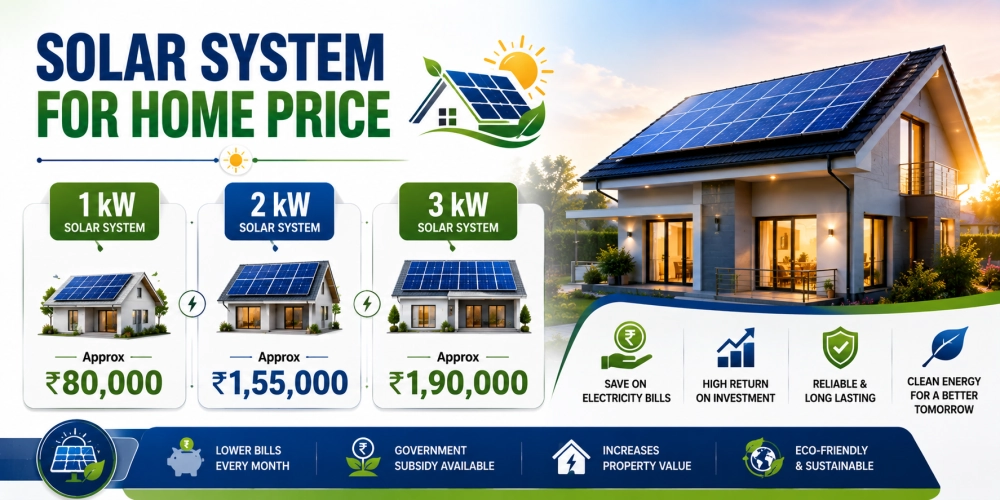
Solar System for Home Price
The correct solar system size should be based on electricity consumption rather than choosing a system simply because it is popular.
1 kW Solar System for Home
A 1 kW system can be suitable for a household with relatively low electricity consumption. It may be useful for homes that want to start with a smaller rooftop system and have limited electricity demand.
2 kW Solar System for Home
A 2 kW system can be suitable for a small or medium household, depending on electricity consumption and rooftop conditions. The system can help offset a meaningful portion of household electricity use.
3 kW Solar System for Home
A 3 kW system is an important residential size because it can suit many households with moderate electricity consumption. Under the PM Surya Ghar subsidy structure, the first 2 kW receives ₹30,000 per kW and the additional 1 kW receives ₹18,000, making the maximum central subsidy for a 3 kW eligible residential system ₹78,000.
Also Read: Residential Solar Panel Installation
However, subsidy eligibility and applicable procedures should always be checked against the latest official guidelines and the relevant DISCOM process.
5 kW Solar System for Home
A 5 kW system may be appropriate for a larger home with higher electricity consumption. The additional capacity can increase solar generation, but the correct size should be based on actual consumption, available roof area and system economics.
For residential systems under the PM Surya Ghar structure, the central subsidy is capped at ₹78,000 once the eligible capacity exceeds 3 kW.
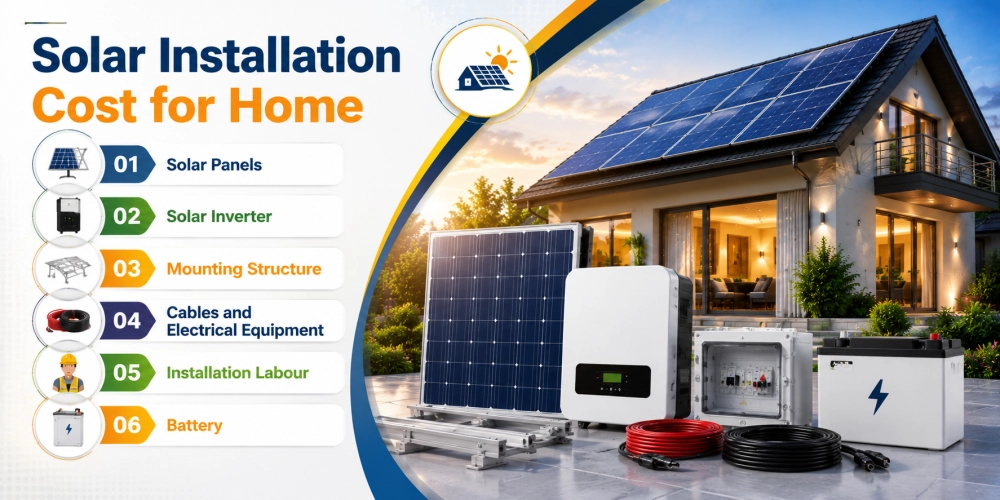
Solar Installation Cost for Home
The cost of solar panel installation for home can be divided into several major components.
1. Solar Panels
Solar modules are responsible for converting sunlight into electricity. Their cost depends on wattage, technology, brand and specifications.
2. Solar Inverter
The inverter converts the electricity generated by the panels into usable AC electricity. The inverter should be properly matched to the system capacity and design.
3. Mounting Structure
Panels need a strong structure that keeps them securely positioned on the roof. The structure can vary depending on:
- Roof type
- Roof angle
- Wind conditions
- Panel arrangement
- Material used
4. Cables and Electrical Equipment
Solar installations require suitable DC and AC cables, connectors, protection devices and other electrical components.
5. Installation Labour
Installation involves mounting the panels, connecting electrical components, testing the system and commissioning it.
6. Battery
A battery is generally not required for a conventional on-grid system, but it becomes important when backup or off-grid operation is required. Because batteries add a significant component to the project, an off-grid or hybrid system can have a higher initial cost.
Solar Roof Installation Cost
The solar roof installation cost depends heavily on the property. An easily accessible RCC rooftop may have different installation requirements from a high-rise building, metal roof or sloped roof.
Factors that can increase installation complexity include:
- Tall buildings
- Difficult roof access
- Weak or unsuitable roof structures
- Long cable runs
- Shading
- Additional civil work
- Special mounting requirements
A professional site survey is therefore important before confirming the final quotation.
Solar System Types and Their Installation Cost
There are three common types of residential solar systems.
On-Grid Solar System
An on-grid system is connected to the electricity grid. It normally does not require a battery for regular operation, making it a comparatively simple residential configuration.
Where applicable, surplus electricity may be handled through the relevant metering mechanism and DISCOM rules.
Also Read: On-Grid Solar System
Off-Grid Solar System
An off-grid system operates independently from the electricity grid and generally requires batteries.
It can be useful in locations where reliable grid electricity is not available. However, battery storage increases the initial investment and introduces additional maintenance and replacement considerations.
Also Read: Off-Grid Solar System
Hybrid Solar System
A hybrid system combines solar generation, grid connection and battery storage. It can provide greater flexibility and backup capability but usually has a higher upfront cost because of the additional equipment.
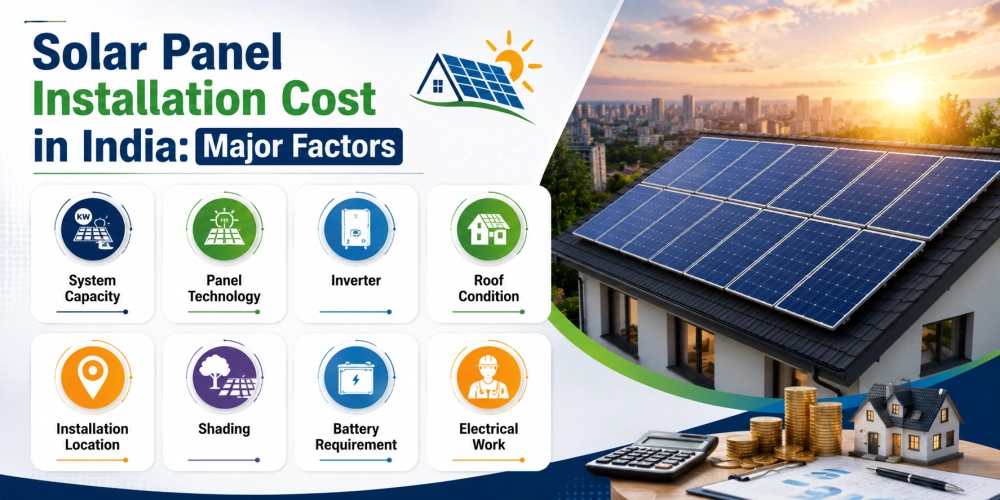
Solar Panel Installation Cost in India: Major Factors
Several factors influence the final solar installation cost.
- System Capacity: A larger system requires more panels and usually a larger inverter and mounting structure.
- Panel Technology: Different panel technologies can have different efficiency, performance and pricing.
- Inverter: The inverter is a major part of the system and should be selected according to the system design.
- Roof Condition: A roof that requires additional structural or civil work can increase the project cost.
- Installation Location: Labour and logistics costs can vary between cities, towns and rural areas.
- Shading: Nearby buildings, trees or other structures can affect system design and generation.
- Battery Requirement: Adding battery storage can substantially increase the overall investment.
- Electrical Work: Additional wiring, protection, earthing or electrical modifications can increase the final cost.
How to Calculate the Right Solar System Size for Your Home
One of the most important steps before installation is determining the right capacity. Start by checking your electricity bills. Look at your monthly electricity consumption in units (kWh).
A simplified approach is: Required Solar Capacity ≈ Monthly Electricity Consumption ÷ Expected Monthly Generation per kW
Use Our Solar Rooftop Calculator
This is only an initial estimate. Actual generation depends on:
- Location
- Solar radiation
- Roof direction
- Panel angle
- Shading
- Weather
- System losses
- Equipment efficiency
For example, a household using substantially more electricity may require a larger system than a household with low monthly consumption.
The Ministry of New and Renewable Energy has also provided indicative rooftop capacity guidance under PM Surya Ghar: households using 0–150 units per month may typically require around 1–2 kW, 150–300 units around 2–3 kW, and households using more than 300 units may require systems above 3 kW.
These are indicative guidelines, not a replacement for a site-specific system design.
How Much Rooftop Space Does Solar Need?
The required rooftop area depends on:
- Panel dimensions
- Panel wattage
- Panel arrangement
- Walkways
- Shading
- Roof shape
- Mounting design
A higher-wattage panel can produce more capacity per panel, potentially reducing the number of panels required. However, the final layout should leave sufficient space for safe installation, maintenance and access.
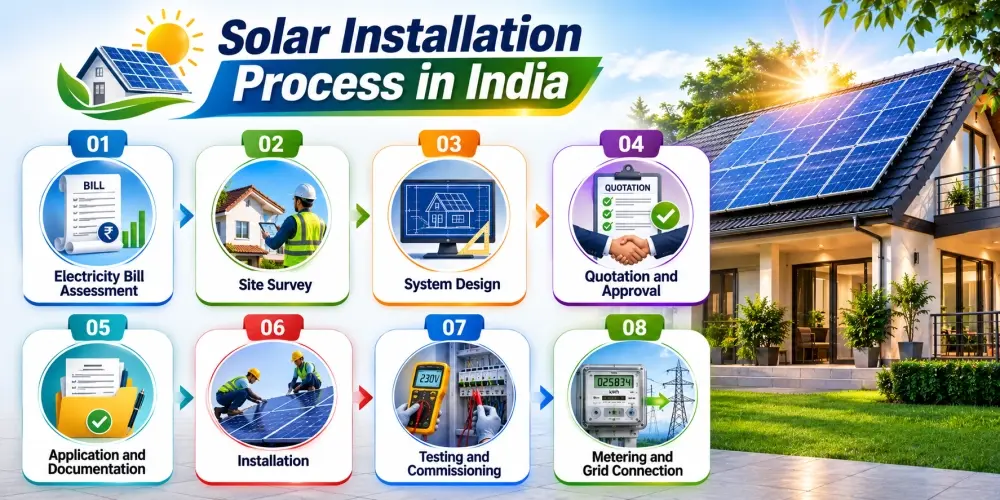
Solar Installation Process in India
The solar installation process in India involves several important steps to ensure safe installation, proper approvals and efficient system performance.
- Electricity Bill Assessment: Review recent electricity bills to understand monthly consumption. Select a suitable solar capacity based on energy requirements and budget.
- Site Survey: Inspect the rooftop for available area, direction, tilt and shading. Check structural strength, roof access and electrical connection requirements.
- System Design: Finalise the solar panels, inverter, mounting structure, cables and safety equipment. Prepare a layout based on roof conditions and expected electricity generation.
- Quotation and Approval: Obtain a detailed quotation covering equipment, installation, taxes, warranties and maintenance. Compare vendors based on quality, service support and total project cost.
- Application and Documentation: Complete the applicable government and DISCOM procedures for grid-connected systems. Eligible residential consumers may apply for subsidy or central financial assistance under the relevant rooftop solar programme.
- Installation: Install the mounting structure, solar panels, inverter, wiring and protection devices.
- Testing and Commissioning: Test system performance, electrical safety and inverter operation before activation.
- Metering and Grid Connection: Complete inspection, net-metering or other applicable grid-connection formalities as required by the local DISCOM.
Solar Panel Installation Cost With Government Subsidy
Government subsidy can reduce the effective cost for eligible residential consumers.
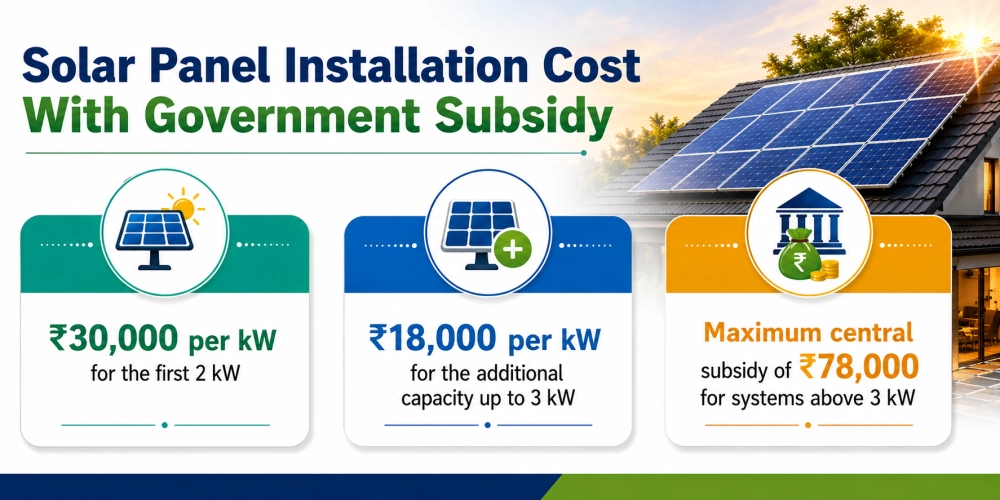
Under PM Surya Ghar, the central financial assistance structure for eligible residential rooftop solar is:
- ₹30,000 per kW for the first 2 kW
- ₹18,000 per kW for the additional capacity up to 3 kW
- Maximum central subsidy of ₹78,000 for systems above 3 kW
For example, the central subsidy calculation for an eligible 3 kW system is: ₹30,000 × 2 kW + ₹18,000 × 1 kW = ₹78,000
The subsidy should not be treated as an automatic discount on every solar quotation. Eligibility, installation requirements, vendor conditions and verification procedures apply.
The Ministry’s rooftop solar programme also notes that CFA is available to residential electricity consumers through the applicable national or state mechanisms, with disbursement linked to installation and verification.
Solar Plant Price and Solar Power Plant Installation Cost
A solar plant price is different from a residential rooftop solar quotation.
Large solar power plants can involve:
- Solar modules
- Inverters
- Mounting systems
- Land
- Roads and civil work
- Transformers
- Transmission infrastructure
- Grid connectivity
- EPC services
- Monitoring systems
- Operations and maintenance
Therefore, solar power plant installation cost depends heavily on project capacity, land conditions, location, grid connection and engineering requirements.
For example, a ground-mounted commercial plant requires infrastructure that is not normally needed for a small residential rooftop system.
Farmers and other eligible project developers may also encounter different schemes and financing structures. PM-KUSUM, for example, includes a component supporting decentralised grid-connected renewable-energy plants in the 500 kW to 2 MW range, subject to the scheme’s applicable conditions.
Solar Panel Cost vs Complete Solar System Cost
This is one of the most important points for homeowners.
| Item | Panel Only | Complete System |
|---|---|---|
| Solar panels | ✓ | ✓ |
| Inverter | ✗ | ✓ |
| Mounting structure | ✗ | ✓ |
| Cables | ✗ | ✓ |
| Protection equipment | ✗ | ✓ |
| Installation | ✗ | ✓ |
| Commissioning | ✗ | ✓ |
| Battery | Optional | Optional |
Therefore, the cheapest panel quotation is not always the cheapest complete solar solution. A better comparison is based on the total installed system, equipment specifications, warranty, expected generation and after-sales service.
How to Compare Solar Installation Quotes
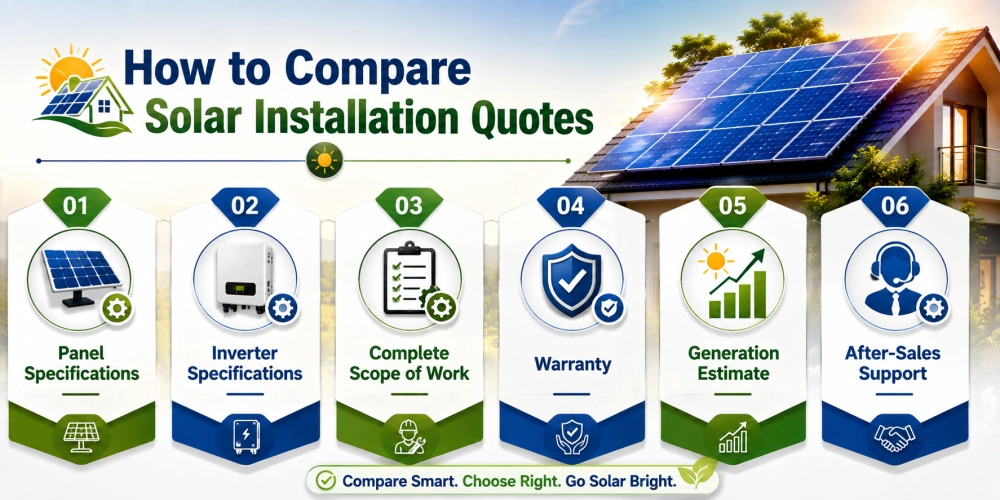
Before selecting an installer, check the following:
- Panel Specifications: Confirm the panel capacity, technology, warranty and applicable certifications.
- Inverter Specifications: Check the inverter capacity, features, warranty and compatibility.
- Complete Scope of Work: Ask whether the quotation includes:
- Mounting structure
- Cables
- Protection equipment
- Installation
- Commissioning
- Documentation
- Applicable metering support
- Warranty: Compare both product and installation warranties.
- Generation Estimate: Ask the installer to provide a realistic expected-generation estimate rather than an unsupported savings promise.
- After-Sales Support: Solar systems are long-term assets. The availability of maintenance and technical support matters.
Is Solar Installation Worth the Cost?
For many homes, rooftop solar can be financially useful because it can reduce the amount of electricity purchased from the grid.
However, the financial benefit depends on:
- Initial system cost
- Electricity consumption
- Electricity tariff
- Solar generation
- Subsidy eligibility
- System performance
- Financing cost
- Maintenance
A simple way to think about the investment is: Solar savings = electricity generated and used/credited × applicable electricity value
The actual payback period should be calculated using the household’s electricity bill and a realistic generation estimate. Avoid choosing an installer based on claims such as “guaranteed zero bill” or a fixed payback period without checking the underlying assumptions.
Solar Panel Maintenance Cost
Rooftop solar generally requires relatively simple maintenance, but it should not be ignored.
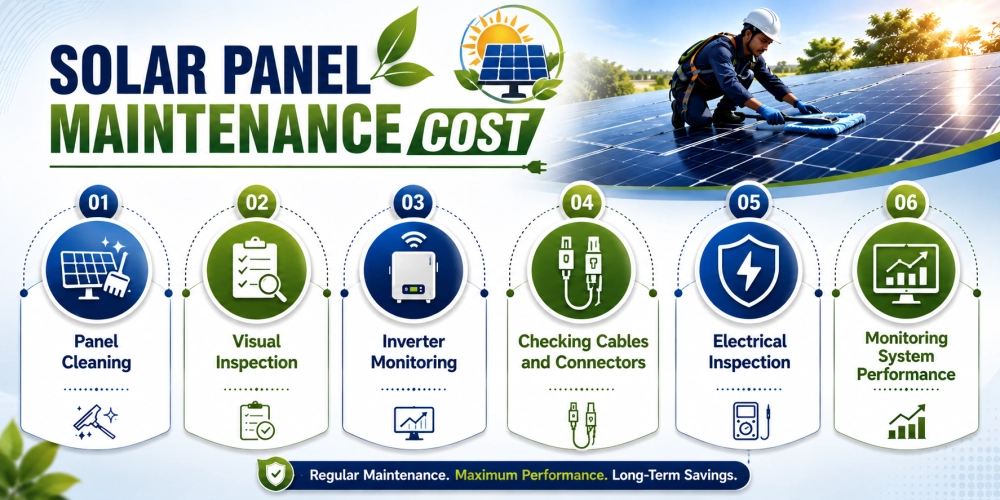
Common maintenance activities include:
- Panel cleaning
- Visual inspection
- Inverter monitoring
- Checking cables and connectors
- Electrical inspection
- Monitoring system performance
Dust is particularly relevant in many parts of India. Dirty panels can reduce the amount of sunlight reaching the modules. Regular monitoring helps identify performance issues early.
Common Mistakes to Avoid When Buying Solar
- Comparing only panel prices: A complete solar system also includes the inverter, mounting structure, cables, safety equipment, installation and commissioning.
- Choosing the cheapest quotation: A low price may indicate differences in equipment quality, warranty coverage, installation standards or included services.
- Ignoring electricity consumption: Select the system capacity according to your monthly electricity usage, future needs and available roof space.
- Skipping the roof inspection: Roof strength, orientation, accessibility and condition can affect installation cost and system performance.
- Overlooking shade: Trees, nearby buildings and water tanks can reduce solar generation. Request a proper shading assessment.
- Assuming subsidy is automatic: Government subsidy depends on eligibility, approved vendors, documentation and applicable DISCOM procedures.
- Neglecting after-sales service: Confirm maintenance support, response time, warranty terms and inverter replacement policies.
- Comparing unequal quotations: Compare similar panel wattage, inverter capacity, warranties, installation scope and expected generation before deciding.
FAQ About Solar Panel Installation Cost
What is the solar panel installation cost in India?
It depends on system size, equipment, roof conditions, installation complexity, location and whether batteries or other additional components are included. A final price should be based on a site survey and system design.
What is the solar panel cost in India?
Solar panel prices vary according to wattage, technology, manufacturer and specifications. Panel cost should be evaluated as part of the complete solar system.
How much does a solar panel for home cost?
The cost depends on the panel’s wattage and specifications. However, homeowners should compare the cost of a complete installed system rather than only individual panels.
What is the solar system price for a home?
It depends mainly on system capacity and configuration. A 1 kW system costs less than a 3 kW or 5 kW system, while battery-based systems generally require additional investment.
How much does one solar panel cost?
There is no universal price because panels are available in different wattages, technologies and brands.
What affects solar installation cost?
System size, panel and inverter selection, roof condition, mounting structure, electrical work, labour, location, battery requirement and other site-specific factors can affect the final cost.
Is solar installation eligible for government subsidy?
Eligible residential consumers may receive central financial assistance under PM Surya Ghar, subject to applicable guidelines and installation/verification requirements.
Is a battery included in the solar system price?
Not necessarily. A standard on-grid system generally does not require a battery, while off-grid and hybrid systems may include battery storage.
How much rooftop space is required?
The required space depends on system capacity, panel wattage, panel dimensions, roof layout, shading and access requirements.
How long does solar installation take?
The physical installation can be completed relatively quickly for a suitable rooftop, but the overall process may also involve documentation, approvals, inspection and metering depending on the project and DISCOM.
Is solar worth installing at home?
For many households, solar can be a useful long-term investment. The decision should be based on electricity consumption, roof suitability, system cost, subsidy eligibility and expected generation.
Get a Solar Installation Cost Estimate for Your Home
If you are considering rooftop solar, do not decide only by looking at the solar panel price.
First understand:
- Your monthly electricity consumption
- Required system capacity
- Available rooftop space
- Type of solar system
- Equipment specifications
- Total installation cost
- Applicable subsidy
- Expected electricity generation
- Warranty and after-sales support
A professional solar assessment can help you choose a system that matches your actual electricity requirements.
SaurSetu can help homeowners explore residential solar solutions, understand system requirements, and get support for the solar installation process, including consultation, documentation and applicable subsidy-related assistance.
Get a personalised solar requirement and installation estimate before making your investment.
Final Takeaway
The solar panel installation cost in India depends on much more than the price of the panels. The complete investment can include the solar modules, inverter, mounting structure, electrical equipment, installation, commissioning and other applicable costs.
For homeowners, the best approach is to first understand electricity consumption and then select the appropriate solar capacity. A 1 kW system may suit a low-consumption household, while a 3 kW, 5 kW or larger system may be more suitable for homes with higher electricity demand.
Eligible residential consumers can also explore the PM Surya Ghar: Muft Bijli Yojana and its applicable central financial assistance. The current official structure provides up to ₹78,000 in central subsidy for eligible residential rooftop systems, subject to the applicable rules and process.
Most importantly, compare the complete installed system, not just the solar panel cost. Check the equipment, warranty, installation scope, generation estimate, subsidy eligibility and after-sales support before making your final decision.
A properly sized and professionally installed rooftop solar system can help a household make better use of India’s abundant sunlight while potentially reducing long-term electricity expenses.