Installing solar panels at home can help reduce electricity bills and lower dependence on the electricity grid. However, the initial installation cost may be a concern for many families. To make rooftop solar more affordable, the Government of India introduced the PM Surya Ghar: Muft Bijli Yojana, which provides financial assistance to eligible residential electricity consumers.
Under the standard central subsidy structure, eligible households can receive up to ₹78,000 for a rooftop solar system of 3 kW or more. The actual installation cost depends on the system capacity, equipment, roof conditions, and the vendor’s quotation.
In this guide, we explain the solar panel subsidy scheme in India, the government subsidy amount, eligibility criteria, installation costs before and after subsidy, required documents, and the online application process. We also explain important points homeowners should check before installing solar panels.
What Is the Solar Panel Subsidy Scheme in India?
The solar panel subsidy scheme is a government initiative that helps eligible households reduce the cost of installing rooftop solar systems. Under the central residential programme, financial assistance is provided according to the eligible solar capacity and applicable scheme guidelines.
The main central government scheme for residential rooftop solar is PM Surya Ghar: Muft Bijli Yojana, launched in February 2024 by the Government of India.
The scheme aims to encourage households to generate electricity using solar panels installed on their rooftops. This can help families reduce their electricity expenses while supporting the country’s renewable energy goals.
What Is the Purpose of the Government Solar Subsidy?
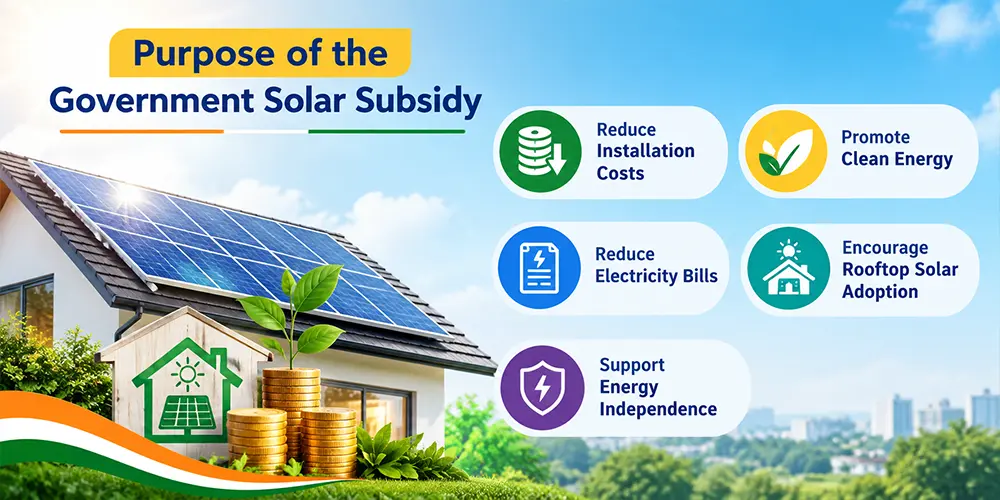
The government solar subsidy has several important objectives:
- Reduce installation costs: Financial assistance lowers the upfront expense for eligible households.
- Promote clean energy: Solar power helps reduce dependence on conventional electricity generation.
- Reduce electricity bills: Households can generate some or much of their electricity during daylight hours.
- Encourage rooftop solar adoption: More families can consider solar power as a long-term energy solution.
- Support energy independence: Households can generate electricity at their own properties instead of relying entirely on grid electricity.
The Ministry of New and Renewable Energy (MNRE) oversees the programme, while electricity distribution companies, commonly called DISCOMs, support the relevant application, technical verification, and grid-connection processes.
Consumers can check scheme information and apply through the official PM Surya Ghar portal.
Solar Panel Government Subsidy Amount in India 2026
The central government subsidy depends on the eligible residential rooftop solar capacity and the applicable scheme guidelines.
For most states, the standard central financial assistance structure is as follows:
| Eligible solar system capacity | Standard central subsidy |
|---|---|
| 1 kW | ₹30,000 |
| 2 kW | ₹60,000 |
| 3 kW | ₹78,000 |
| 4 kW | ₹78,000 |
| 5 kW | ₹78,000 |
| 10 kW | ₹78,000 |
These amounts represent the standard central subsidy structure for eligible residential installations. Special-category states may have different rates, and applicants should verify the applicable rules before installation.
Also Read: Best Solar Panels in India
How Is the Solar Subsidy Calculated?
For the standard residential subsidy structure, the central assistance is calculated using the following rates:
- ₹30,000 per kW for the first 2 kW.
- ₹18,000 per kW for the additional 1 kW.
- No additional central subsidy for capacity above 3 kW under the standard individual residential structure.
For example, a household installing a 2 kW eligible system may receive ₹60,000 in central financial assistance. A household installing a 3 kW system may receive ₹78,000.
Installing a larger system does not automatically increase the standard central subsidy beyond ₹78,000. However, a larger system may generate more electricity if the roof, sunlight conditions, and household requirements support it.
The subsidy is calculated using the eligible capacity and prescribed rates. It is not necessarily a fixed percentage of the actual price quoted by the solar installer.
Source: MNRE’s operational guidelines for the PM Surya Ghar scheme. Verify the latest applicable provisions before submitting an application.
Solar Subsidy for Home: Eligibility Criteria
The solar subsidy for home installation is intended for eligible residential electricity consumers. Meeting the eligibility conditions is important because purchasing solar panels alone does not guarantee subsidy approval.
Who Can Apply for Solar Panel Subsidy?
Homeowners should generally check the following conditions:
- Residential electricity connection: The property must have an eligible residential electricity connection from the relevant DISCOM.
- Eligible rooftop installation: The proposed system must meet the scheme’s requirements for grid-connected rooftop solar.
- Registered vendor: The installation must follow the applicable scheme process, including the use of a registered vendor where required.
- Technical compliance: The solar system must satisfy the relevant technical standards, inspection, and commissioning requirements.
- Correct application details: Electricity consumer information, applicant details, and bank information must be accurate.
- Scheme compliance: The applicant must meet the applicable rules concerning previous subsidy claims and eligible installations.
The precise conditions should be checked on the official portal because requirements can vary by application stage and applicable scheme provisions.
Also Read: Residential Solar Panel Installation
Can Tenants Apply for Solar Subsidy?
Tenants may need permission from the property owner to install rooftop solar panels. Eligibility also depends on the electricity connection, the right to use the roof, and the scheme’s application requirements.
Before investing in a solar system, tenants should obtain the necessary permission and confirm the application procedure with the relevant DISCOM.
Is Subsidy Available for Commercial Buildings?
The standard PM Surya Ghar residential subsidy is intended for eligible residential electricity consumers. Commercial and industrial electricity connections do not qualify for this standard residential subsidy.
Businesses interested in rooftop solar should explore applicable commercial solar programmes, financing options, and state-specific incentives instead.
Also Read: Commercial Solar Panel Installation
Government Solar Panel Price: Cost Before and After Subsidy
One of the most common questions is: What is the actual solar panel price after government subsidy?
The final price depends on the solar system’s capacity, panel and inverter specifications, mounting structure, wiring, installation work, and site conditions. Therefore, two households installing the same system capacity may receive different quotations.
Solar Panel Installation Cost After Government Subsidy
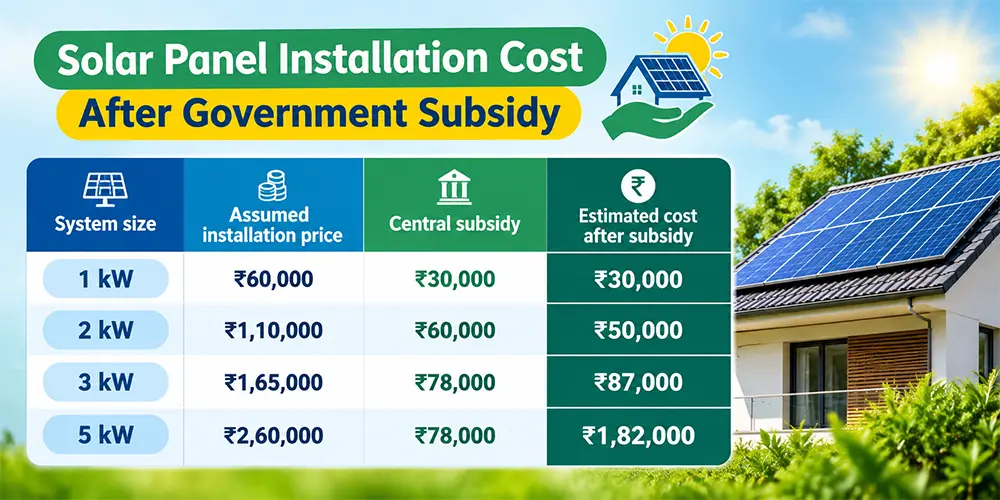
The following table provides illustrative calculations to show how the subsidy reduces the initial cost.
| System size | Assumed installation price | Central subsidy | Estimated cost after subsidy |
|---|---|---|---|
| 1 kW | ₹60,000 | ₹30,000 | ₹30,000 |
| 2 kW | ₹1,10,000 | ₹60,000 | ₹50,000 |
| 3 kW | ₹1,65,000 | ₹78,000 | ₹87,000 |
| 5 kW | ₹2,60,000 | ₹78,000 | ₹1,82,000 |
Important: These installation prices are examples, not government-fixed prices or verified current market quotations. Actual prices vary by location, equipment, installation scope, and vendor. The calculation also assumes that the full stated subsidy is approved and received.
For example, suppose a homeowner receives a quotation of ₹1,65,000 for an eligible 3 kW rooftop solar system. If the homeowner qualifies for the standard central subsidy of ₹78,000, the effective cost would be:
₹1,65,000 − ₹78,000 = ₹87,000
This calculation excludes any additional expenses not included in the quotation and assumes the subsidy is successfully approved.
What Factors Affect Solar Installation Cost?
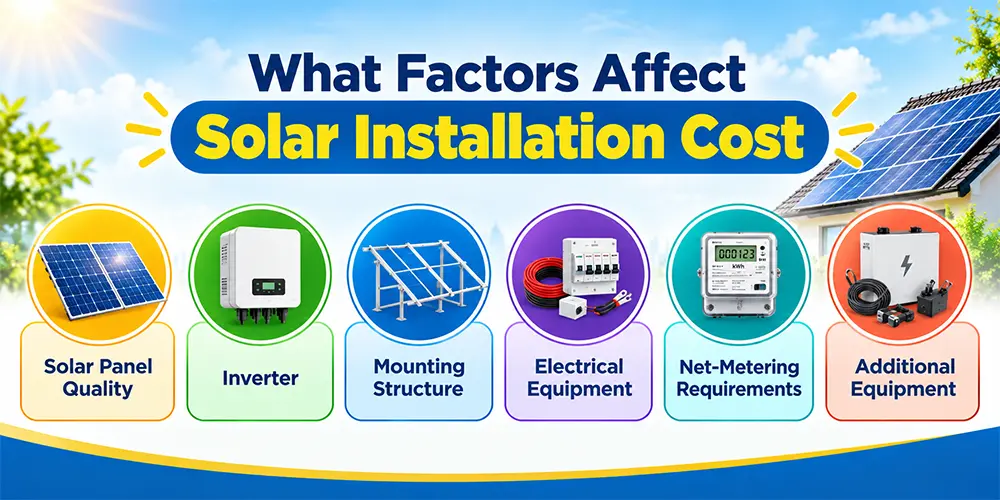
Several factors influence the government solar panel price and the final amount paid by the customer.
- Solar panel quality: Panel technology, efficiency, specifications, and warranty affect the system price.
- Inverter: The inverter converts the electricity generated by solar panels into usable AC electricity.
- Mounting structure: Roof type, height, and installation conditions may affect the mounting cost.
- Electrical equipment: Wiring, earthing, protection devices, and other safety components are part of a proper installation.
- Net-metering requirements: Applicable metering, connection, and DISCOM-related charges should be clarified.
- Additional equipment: Batteries, backup systems, and optional electrical upgrades may increase the total cost.
Before selecting a vendor, ask for a written quotation that lists the equipment, capacity, warranties, installation charges, and any additional costs.
Does the Government Provide Free Solar Panels?
The subsidy does not automatically make every rooftop solar installation completely free. It reduces the eligible installation cost, but the homeowner may need to pay the remaining amount.
Electricity bills may also continue because households can consume grid electricity when solar generation is insufficient, such as at night or during periods of low sunlight.
How to Apply for Solar Panel Subsidy Online
Eligible homeowners can follow the official application process for the PM Surya Ghar scheme. The following steps provide a general overview; applicants should follow the latest instructions displayed on the portal.
Step 1: Register on the Official Portal
Visit pmsuryaghar.gov.in.
Select the relevant state and electricity distribution company, then enter the requested consumer and electricity connection details. Complete the registration process using the required information.
Step 2: Submit the Rooftop Solar Application
Submit the application with the requested details about your electricity connection and proposed rooftop solar installation.
Complete any applicable technical feasibility or approval steps required by the portal or DISCOM before proceeding.
Step 3: Select a Registered Solar Vendor
Check the vendor’s registration status through the applicable scheme process. Compare quotations and ask about the proposed system capacity, panel specifications, inverter, warranties, installation charges, and after-sales service.
Do not select a vendor only because it offers the lowest price. Installation quality and service support are important for long-term performance.
Step 4: Install the Solar System
After completing the required preliminary steps, arrange installation according to the scheme’s technical requirements.
Keep copies of the quotation, invoices, equipment details, and other installation documents that may be needed during verification.
Step 5: Complete Inspection and Net Metering
After installation, follow the portal’s instructions for uploading the required details and completing the relevant inspection and commissioning procedures.
The DISCOM may verify the installation and complete the applicable net-metering process. A net meter records electricity flow according to the applicable connection and billing arrangement.
Step 6: Submit Bank Details and Claim the Subsidy
Complete the required bank-account verification and subsidy claim formalities on the portal.
The subsidy is transferred according to the applicable scheme process after successful verification. Approval and payment are subject to compliance with the relevant requirements, so applicants should not assume that the subsidy will arrive immediately.
Documents Required for Solar Panel Government Subsidy
The exact documents and information required may vary depending on the application stage and the portal’s instructions.
Homeowners should keep the following information ready:
- Residential electricity bill or consumer account details.
- Registered mobile number and applicant information.
- Bank account details and required verification information.
- Identity documents like Aadhaar and PAN cards or other supporting documents, if requested.
- Solar installation details and vendor information.
- Commissioning or inspection records, where applicable.
Make sure the details entered during registration match the relevant records. Incorrect bank information, electricity consumer details, or incomplete installation information may delay verification.
Always follow the current checklist provided on the official portal instead of relying only on third-party articles.
State-Wise Solar Panel Subsidy in India
The central government provides residential rooftop solar assistance under the applicable national scheme. Additional state-level support, where available, depends on separate government policies, eligibility requirements, and current notifications.
Solar Panel Subsidy in Uttar Pradesh
Residential consumers in Uttar Pradesh should check the central subsidy and any currently applicable state-level benefits before selecting a system.
Applicants should also confirm the requirements of their local DISCOM and consult the relevant Uttar Pradesh renewable-energy authorities, including UPNEDA, for current information.
SaurSetu can help prospective customers understand their installation requirements and request a quotation. However, the availability and approval of government subsidy must be confirmed through the official process.
Also Read: Solar Subsidy in UP: Complete Guide to Solar Panel, Rooftop & Solar Pump Subsidy
Solar Panel Subsidy in Maharashtra
Homeowners in Maharashtra should check the standard central subsidy and any additional state benefits officially available to them.
They should also verify the relevant DISCOM’s application and net-metering requirements before installation. Additional benefits should not be assumed unless supported by a current official notification.
Solar Subsidy in Delhi and Other States
Consumers in Delhi and other states should check the national portal and their respective state renewable-energy agencies or DISCOMs.
Before relying on a state subsidy, confirm:
- Whether the benefit is currently active.
- Whether it applies to residential consumers.
- Whether it can be combined with central assistance.
- Which system capacities and installations qualify.
- Whether a separate application or approval is necessary.
State incentives and scheme rules can change. For this reason, a state-wise subsidy table should always be updated using official sources before publication.
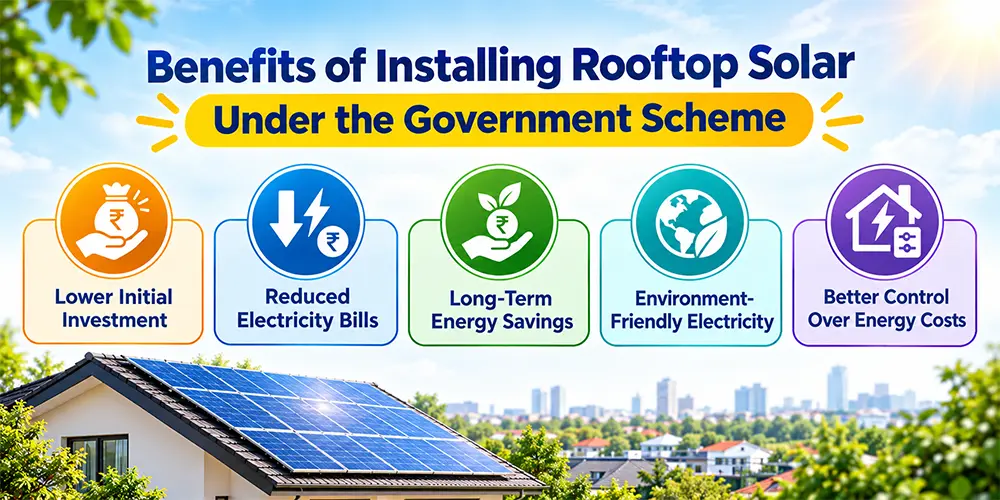
Benefits of Installing Rooftop Solar Under the Government Scheme
Installing rooftop solar can provide several financial and practical benefits for eligible households.
- Lower Initial Investment: The solar subsidy reduces the upfront cost of an eligible residential system. This can make rooftop solar more affordable for households that might otherwise delay installation.
- Reduced Electricity Bills: Solar panels generate electricity during daylight hours. When the system generates power that the household can use, the amount of electricity purchased from the grid may decrease. Actual savings depend on consumption patterns, system capacity, sunlight, electricity tariffs, and the applicable net-metering arrangement.
- Long-Term Energy Savings: A properly designed and maintained system can generate electricity for many years. Long-term financial benefits depend on equipment quality, maintenance, performance, and the initial installation cost.
- Environment-Friendly Electricity: Solar power generates electricity without directly burning fossil fuels during operation. Greater rooftop solar adoption can support cleaner electricity generation and reduce dependence on conventional energy sources.
- Better Control Over Energy Costs: Generating part of a household’s electricity can help reduce exposure to some changes in grid electricity costs. However, solar panels do not guarantee a zero electricity bill under every situation.
Common Mistakes to Avoid When Applying for Solar Subsidy
Before applying for a government solar subsidy, avoid these common mistakes:
- Choosing an unverified vendor: Check registration and relevant scheme requirements before signing a contract.
- Ignoring the application procedure: Follow the required portal and DISCOM steps rather than assuming that any installation automatically qualifies.
- Assuming larger systems receive more subsidy: The standard central subsidy for individual residential installations is capped at ₹78,000 for systems of 3 kW or more, subject to applicable rules.
- Confusing benchmark cost with market price: The government subsidy calculation and a vendor’s installation quotation are not necessarily based on the same price.
- Ignoring warranties: Check the warranties for panels, inverter, and installation workmanship.
- Trusting guaranteed-subsidy claims: No private installer should be assumed to guarantee government approval or payment.
- Ignoring future service needs: Ask about maintenance, fault support, and warranty claims before choosing a vendor.
A careful comparison of quotations and scheme requirements can help prevent unexpected costs and application problems.
Frequently Asked Questions About Solar Panel Subsidy
1. How much government subsidy is available for solar panels at home?
Under the standard central subsidy structure, eligible residential consumers can receive ₹30,000 for 1 kW, ₹60,000 for 2 kW, and ₹78,000 for 3 kW or more. Applicable rates may differ in special-category states, and all claims remain subject to scheme conditions.
2. Is the solar panel subsidy ₹78,000 for a 3 kW system?
Yes, ₹78,000 is the standard central subsidy for an eligible 3 kW residential rooftop solar system in most states. The applicant must complete the applicable installation, verification, and subsidy claim requirements.
3. What is the price of a 3 kW solar system after subsidy?
The final price depends on the vendor’s quotation and the equipment included. For example, if a 3 kW system costs ₹1,65,000 and the eligible central subsidy of ₹78,000 is approved, the effective cost would be ₹87,000.
4. Can I get a government subsidy for a 5 kW solar system?
Eligible residential consumers may receive the standard central subsidy capped at ₹78,000 for a 5 kW system. The remaining cost depends on the installation quotation, and the system should be sized according to household electricity needs.
5. How can I apply for solar panel subsidy online?
Visit the official PM Surya Ghar portal, register using the required electricity consumer details, complete the application process, follow the applicable approval steps, and use a registered vendor where required. After installation, complete the required verification and subsidy claim formalities.
6. Is solar subsidy available for commercial buildings?
The standard residential subsidy under PM Surya Ghar does not apply to commercial and industrial electricity connections. Businesses should check other applicable government programmes, state incentives, and financing options.
7. Does solar subsidy make electricity completely free?
No. The subsidy reduces the installation cost, and solar generation can reduce electricity purchases from the grid. The final bill depends on household consumption, solar generation, fixed charges, and the applicable electricity billing arrangement.
8. How long does it take to receive the solar subsidy?
The processing time depends on application completeness, installation verification, bank details, and the applicable approval process. Follow the portal’s current instructions and contact the relevant authority if your application remains pending.
Conclusion
The solar panel subsidy scheme in India can make rooftop solar more affordable for eligible residential consumers. Under PM Surya Ghar: Muft Bijli Yojana, the standard central subsidy is ₹30,000 for 1 kW, ₹60,000 for 2 kW, and up to ₹78,000 for 3 kW or more, subject to applicable rules.
Before installing solar panels, check your eligibility, compare vendor quotations, understand the complete installation cost, and follow the official application process. Also confirm whether any additional state subsidy is currently available.
If you are planning to install rooftop solar at your home, SaurSetu can help you explore suitable solar installation options and request a quotation based on your property and electricity requirements. Always verify subsidy eligibility and approval through the official government process before making a financial commitment.
Also Read: Solar Panel Installation Cost in India 2026: Complete Home Solar Price Guide