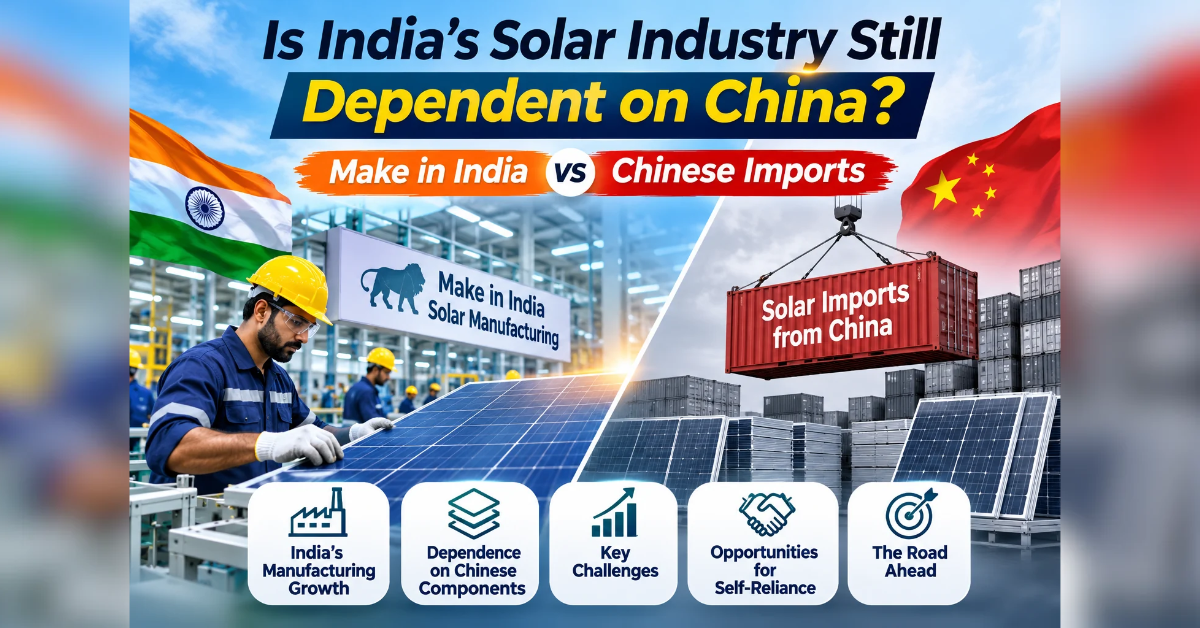
Is India's Solar Industry Still Dependent on China? The Truth Behind India's Solar Manufacturing Ambitions
India is rapidly expanding its renewable energy capacity, and solar power is playing a major role in this transformation. From residential rooftop installations to large-scale solar parks, the country is investing heavily in clean energy. But behind this impressive growth lies an important question: Can India manufacture its own solar panels, or is its solar industry still dependent on China?
The government’s Make in India initiative and domestic manufacturing policies aim to establish India as a global solar manufacturing hub. However, despite the growth of Indian solar panel factories, the country continues to depend heavily on China for one of the most important components of solar technology: solar cells.
This creates a growing debate between domestic manufacturing ambitions and the reality of international supply chains.
Let’s understand where India stands, why China remains important, and what challenges could shape the future of India’s solar industry.
1. India’s Solar Manufacturing Industry Is Growing, But Is It Self-Reliant?
India has made considerable progress in solar panel manufacturing over recent years. Several domestic companies have expanded their production facilities, and government policies are encouraging investment in local manufacturing.
However, manufacturing a complete solar panel requires multiple components, technologies, and production stages.
One important distinction is between solar modules and solar cells.
- Solar cells: These are the core components that convert sunlight into electricity.
- Solar modules: These are assembled units containing interconnected solar cells, protected by glass and other materials.
India has developed substantial solar module manufacturing capacity, but its domestic solar cell production has not grown at the same pace.
According to government estimates cited in July 2026 industry reporting, India’s solar module manufacturing capacity is approximately 200 GW, while installed solar cell manufacturing capacity is around 27 GW. Industry researchers estimate that effective operating cell capacity is considerably lower, at approximately 16–18 GW.
This difference highlights a major challenge: India can manufacture solar modules at scale, but it still needs a stronger domestic supply of solar cells.
2. Why Does India Still Depend on China for Solar Cells?
China has established itself as a major global centre for solar manufacturing. Its large production facilities, advanced technology, established supply chains, and manufacturing experience have helped it maintain a strong position in the industry.
India, on the other hand, is still developing several parts of its solar manufacturing ecosystem.
There are three major reasons behind this dependence.
- Advanced Manufacturing Technology
Solar cell manufacturing requires specialised equipment, technical knowledge, research, and significant investment. China has spent years developing these capabilities, while India is still expanding its domestic manufacturing infrastructure.
- Lower Manufacturing Costs
Chinese manufacturers benefit from large-scale production and established supply networks. This allows them to manufacture solar components at competitive prices.
Indian manufacturers face higher production costs when domestic components are limited or unavailable.
- Established Supply Chains
China has a well-developed ecosystem for solar manufacturing, covering several stages of production. India still depends on international suppliers for certain critical components, equipment, and technical expertise.
As a result, reducing dependence on Chinese imports requires more than building additional solar panel factories.
3. Make in India vs. Chinese Imports: Where Is the Real Challenge?
India’s Make in India initiative aims to strengthen domestic manufacturing, create employment, attract investment, and reduce dependence on imported products.
In the solar sector, domestic manufacturing requirements are intended to encourage companies to use locally produced solar cells and modules.
However, policies alone cannot immediately create a complete manufacturing ecosystem.
According to a Reuters industry report published on July 23, 2026, restrictions affecting access to domestically manufactured solar cells created supply challenges for several Indian module manufacturers.
The report highlighted that:
- Around one-third of small and medium-sized solar module manufacturers had halted production, according to their industry association.
- Some manufacturers were facing waiting periods of six to eight months for domestic solar cells.
- Domestic solar panels using locally manufactured cells were becoming significantly more expensive than products using imported Chinese cells.
- Industry participants warned that the disruption could affect jobs, investments, and solar project timelines.
This situation highlights an important policy challenge.
India wants to promote domestic manufacturing, but manufacturers also need a reliable supply of affordable components to continue production.
The objective should not simply be to replace imports overnight. It should be to develop a competitive domestic industry capable of meeting demand without disrupting the solar market.
4. How Is China’s Export Policy Affecting India’s Solar Industry?
India’s dependence on China is not limited to solar cells.
The country also faces challenges in accessing certain solar manufacturing technologies, equipment, and technical support.
Industry sources cited in the July 2026 Reuters report said that Chinese export restrictions could make it more difficult for Indian companies to establish advanced solar cell manufacturing facilities.
Building a solar cell factory requires:
- Significant financial investment.
- Advanced production machinery.
- Skilled technical professionals.
- Reliable raw material supplies.
- Research and development facilities.
- Time for installation, testing, and commercial production.
This means that even if Indian companies are willing to invest, expanding domestic production capacity is not an overnight process.
Industry experts estimate that closing India’s solar cell supply gap could take approximately three to five years.
This makes technological development and international partnerships important parts of India’s long-term solar strategy.
5. What Does This Mean for India’s Solar Industry and Consumers?
The challenges in domestic solar manufacturing can affect more than manufacturers. They can also influence solar project developers, installation companies, businesses, and residential consumers.
Higher Solar Panel Prices
When domestic solar cells are difficult to obtain, manufacturers may face increased production expenses. These costs can eventually affect solar panel prices.
Delays in Solar Projects
Solar developers require a consistent supply of modules to complete projects within planned timelines. Component shortages can delay installations and project commissioning.
Pressure on Small Manufacturers
Smaller solar module manufacturers often have fewer resources to manage supply chain disruptions and rising production costs.
Impact on Employment
Manufacturing delays and factory shutdowns can affect workers across the solar manufacturing ecosystem.
Challenges for Renewable Energy Targets
India has ambitious renewable energy goals. Any slowdown in domestic solar manufacturing or project deployment could make these targets more difficult to achieve.
For consumers, the situation highlights why solar panel quality, manufacturer credibility, product availability, warranty coverage, and installation support are important when choosing a solar system.
6. Can India Become Independent of Chinese Solar Manufacturing?
India has the potential to become a major global solar manufacturing hub, but achieving complete independence will require a long-term strategy.
Here are five areas where India needs to focus.
- Increase Domestic Solar Cell Production
India needs to expand solar cell manufacturing facilities to reduce the gap between module and cell production capacity.
- Invest in Advanced Technology
Domestic companies need access to modern manufacturing equipment, research facilities, and technical expertise.
- Strengthen the Domestic Supply Chain
Developing reliable local suppliers for important solar components can reduce exposure to international supply disruptions.
- Support Small and Medium Manufacturers
Smaller manufacturers need access to affordable components, financial support, and stable manufacturing policies to compete effectively.
- Focus on Research and Innovation
Investment in next-generation solar technologies, manufacturing efficiency, and higher-performance solar cells can improve India’s long-term competitiveness.
India does not necessarily need to eliminate every international partnership to become self-reliant. Instead, it needs the ability to manufacture critical solar components competitively and maintain a dependable domestic supply chain.
7. The Future of India’s Solar Industry: Opportunity or Challenge?
India’s solar manufacturing journey is at an important stage.
The country has already demonstrated its ability to expand solar module production and attract investment in renewable energy. However, the shortage of domestic solar cells shows that manufacturing capacity and manufacturing independence are two different things.
China’s established position in the global solar supply chain remains a major challenge for India’s ambitions.
At the same time, this challenge creates an opportunity for Indian manufacturers, technology developers, investors, and policymakers to build a stronger domestic ecosystem.
The coming years will be important in determining whether India can move beyond solar module assembly and establish itself as a competitive manufacturer of solar cells and other critical components.
Conclusion: India Needs More Than Solar Panel Factories to Become Self-Reliant
So, is India’s solar industry still dependent on China?
Yes, particularly when it comes to solar cells, advanced manufacturing technology, and certain critical components.
India has made significant progress in solar module manufacturing, but the gap in domestic cell production highlights how much work remains.
The success of Make in India in the solar sector will depend on technological development, investment, reliable supply chains, and consistent manufacturing policies.
Building factories is only the beginning. Creating a complete, competitive, and sustainable solar manufacturing ecosystem is the real goal.
India’s renewable energy future is promising, but achieving solar manufacturing independence will require time, planning, and continued investment.