India is rapidly expanding its solar energy capacity as households, businesses, industries, and farmers look for cleaner and more affordable electricity. Solar panels are an important part of this change because they convert sunlight into electricity and help reduce dependence on conventional power sources.
However, choosing the right solar panel is not just about comparing prices or wattage. Buyers must also consider manufacturing quality, panel efficiency, product warranties, certifications, after-sales support, and the manufacturer’s ability to supply products over the long term.
Several Indian companies manufacture solar photovoltaic (PV) modules, while others also produce solar cells or provide complete solar energy solutions. Each company has a different product range, manufacturing capability, and market focus.
In this guide, we explore the top solar panel manufacturers in India, explain how solar panels are manufactured, compare leading companies, and share practical tips to help you choose the right manufacturer for your requirements.
Top 15 Solar Panel Manufacturers in India
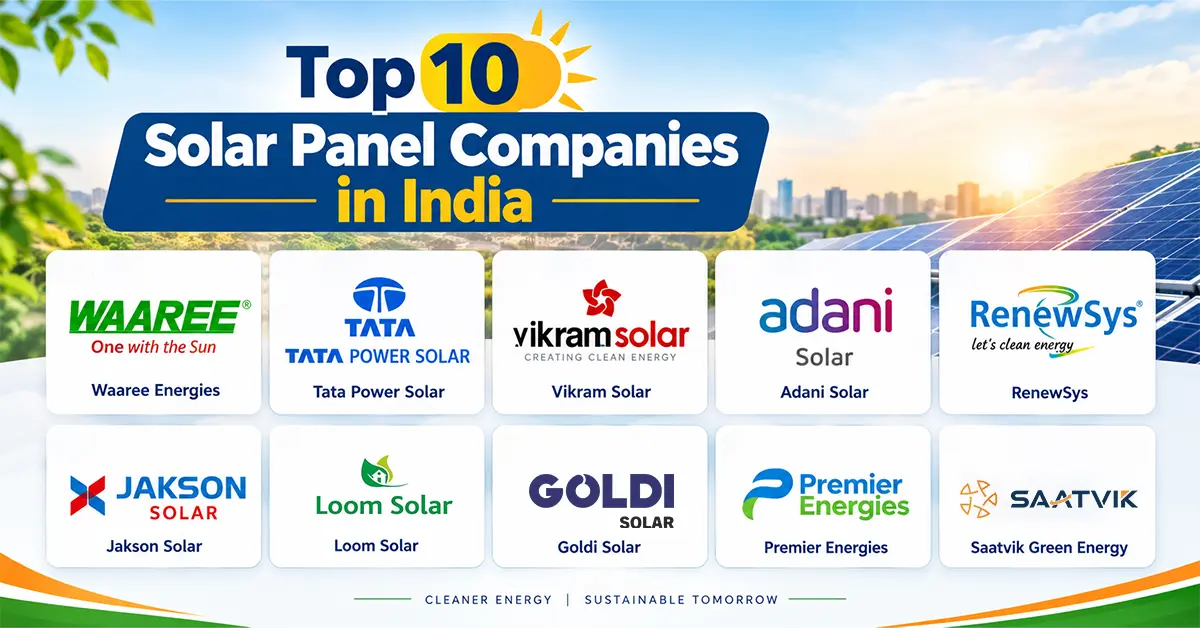
India has a growing network of solar panel manufacturing companies serving residential, commercial, industrial, and large-scale solar projects. The following companies are worth considering when researching solar panels for a new installation or a bulk purchase.
This is a practical shortlist, not a strict ranking of product quality. Manufacturing capacity, technology, certifications, and product availability can change, so buyers should verify current information before making a purchase.
1. Waaree Energies
Waaree Energies is a major Indian solar module manufacturer with a broad product portfolio and a strong presence in domestic and international markets. Its offerings include high-efficiency photovoltaic modules for utility-scale, commercial, industrial, and rooftop solar applications.
The company has expanded its manufacturing capabilities and offers newer technologies, including TOPCon modules. In December 2025, Waaree reported that its Indian solar module manufacturing capacity, including Indosolar, had reached 20.17 GW.
Suitable for: Buyers comparing large-scale module suppliers, rooftop products, and high-volume procurement options.
2. Adani Solar
Adani Solar is part of the Adani Group and operates in solar manufacturing, including photovoltaic cells and modules. Its integrated manufacturing approach is relevant to India’s effort to strengthen domestic solar supply chains.
The company serves the utility-scale and commercial solar markets, where buyers may need large quantities of modules and consistent technical specifications.
Suitable for: Large solar projects, commercial installations, and buyers looking for manufacturers with cell and module capabilities.
3. Tata Power Solar
Tata Power Solar is an established name in India’s solar sector. Its business includes solar module manufacturing as well as solar project and installation services through its wider solar operations.
Its presence across manufacturing and project execution can be useful for customers comparing equipment and end-to-end solar solutions. However, buyers should confirm which entity will supply the modules and which will handle installation or project delivery.
Suitable for: Residential rooftop customers, commercial buyers, and businesses looking for an established solar solutions provider.
4. Vikram Solar
Vikram Solar manufactures photovoltaic modules for domestic and international markets. Its portfolio serves different solar project sizes, including commercial, industrial, and utility-scale installations.
When evaluating its products, compare the exact module model, efficiency, temperature coefficient, product warranty, and performance warranty. These specifications help determine whether a panel is suitable for a particular location and project.
Suitable for: Buyers seeking established module suppliers for rooftop and larger solar projects.
5. Premier Energies
Premier Energies is involved in solar cell and module manufacturing. Its manufacturing capabilities are relevant to the growing demand for domestically produced solar equipment.
Solar cell manufacturing is an important part of the supply chain because cells are the main electricity-generating components inside a solar module. Buyers should distinguish between a company’s cell production capacity and its module assembly capacity when comparing manufacturers.
Suitable for: Commercial and utility-scale procurement and buyers evaluating domestic cell and module production.
6. Goldi Solar
Goldi Solar is an Indian solar module manufacturer offering products for different photovoltaic applications. Its manufacturing operations and module portfolio make it another company to include when comparing domestic solar suppliers.
Before selecting a product, review its rated power, dimensions, efficiency, operating temperature range, mechanical load specifications, and applicable certifications. These details matter more than wattage alone.
Suitable for: Rooftop projects, commercial installations, and buyers comparing Indian module suppliers.
7. RenewSys India
RenewSys operates in solar module manufacturing and the production of important photovoltaic components, including encapsulants and backsheets. These materials help protect solar cells and support module performance over time.
Its presence in both modules and component manufacturing makes it relevant to buyers and businesses researching India’s wider solar manufacturing ecosystem.
Suitable for: Buyers evaluating module suppliers and businesses interested in solar components and manufacturing supply chains.
8. Emmvee
Emmvee is an Indian solar manufacturing company associated with solar cells and photovoltaic modules. Its product portfolio and manufacturing development are relevant to buyers comparing newer high-efficiency module technologies.
When assessing a particular model, check whether the product uses TOPCon, PERC, or another cell technology. Also confirm the module’s certification, manufacturing location, and warranty terms.
Suitable for: Commercial, industrial, and large-scale solar projects requiring technical product comparisons.
9. Jakson Solar
Jakson Solar is part of the broader Jakson energy business. Its activities include solar module manufacturing and other energy-related solutions.
Buyers should distinguish between the company’s module manufacturing operations and its EPC or project services. A supplier’s ability to manufacture panels and its ability to design or install a complete solar system are related but different capabilities.
Suitable for: Commercial buyers and project developers comparing solar equipment and integrated energy solutions.
10. Rayzon Solar
Rayzon Solar is an Indian solar module manufacturer with a focus on photovoltaic products for different project requirements. Its offerings can be evaluated alongside other domestic manufacturers based on technology, module output, quality documentation, and availability.
For bulk procurement, buyers should also confirm production schedules, delivery commitments, transport arrangements, and procedures for handling damaged or defective modules.
Suitable for: EPC companies, distributors, commercial installations, and larger solar projects.
11. Saatvik Green Energy
Saatvik Green Energy operates in solar module manufacturing and also has a presence in solar project solutions. Its business is relevant to customers researching domestic module suppliers and companies that participate in broader solar project delivery.
Buyers should check the exact product specifications and confirm whether a quoted module model is currently available and meets the project’s regulatory requirements.
Suitable for: Commercial installations, EPC procurement, and project-based solar equipment requirements.
12. Insolation Energy
Insolation Energy, which uses the INA Solar brand, is involved in solar photovoltaic module manufacturing. It is another option for buyers comparing Indian module makers, especially when assessing suppliers for project-based or bulk requirements.
Compare product quality, warranty documentation, current manufacturing capability, and service arrangements before placing an order.
Suitable for: Commercial projects, solar installers, distributors, and buyers evaluating domestic module suppliers.
13. Loom Solar
Loom Solar is known for solar products and solutions aimed at residential and smaller commercial customers. Its range is relevant to people researching rooftop panels and solar equipment for homes or small businesses.
However, buyers should verify whether a specific product is manufactured by Loom Solar itself or sourced from another manufacturer. A solar product brand and a solar panel manufacturing company are not necessarily the same.
Suitable for: Homeowners and small businesses comparing solar panels and related equipment.
14. Bluebird Solar
Bluebird Solar is a name buyers may encounter when researching solar modules and solar products in India. Before treating it as a direct manufacturing option for a particular project, verify its current manufacturing facilities, model details, and applicable certifications.
This check helps buyers distinguish between direct manufacturers, brands, distributors, and system suppliers.
Suitable for: Buyers comparing solar products, subject to verification of the specific manufacturer’s credentials.
15. Kosol Energie
Kosol Energie is another company to investigate when researching solar products and suppliers in India. Buyers should review its current module portfolio, manufacturing capabilities, technical specifications, and product documentation before making a procurement decision.
For projects requiring a complete solar installation, confirm whether the company supplies only equipment or also provides design, installation, and commissioning services.
Suitable for: Buyers exploring solar equipment and solutions, subject to product and manufacturing verification.
Comparison of Leading Solar Panel Manufacturers in India
The following table provides a starting point for comparing the companies discussed above.
| Company | Main area to evaluate | Best comparison criteria |
|---|---|---|
| Waaree Energies | Solar modules | Technology, scale, product range |
| Adani Solar | Cells and modules | Manufacturing integration |
| Tata Power Solar | Modules and solar solutions | Equipment and project services |
| Vikram Solar | Solar modules | Efficiency, warranty, project experience |
| Premier Energies | Cells and modules | Cell production and technology |
| Goldi Solar | Solar modules | Product range and availability |
| RenewSys | Modules and components | Module and material portfolio |
| Emmvee | Cells and modules | Technology and production capabilities |
| Jakson Solar | Modules and energy solutions | Manufacturing and EPC services |
| Rayzon Solar | Solar modules | Specifications and supply capacity |
| Saatvik Green Energy | Modules and project solutions | Product availability and project support |
| Insolation Energy | Solar modules | Product range and documentation |
| Loom Solar | Solar products | Residential suitability and sourcing |
| Bluebird Solar | Solar products and modules | Manufacturing credentials |
| Kosol Energie | Solar products and solutions | Product portfolio and service scope |
Largest Solar Panel Manufacturers in India by Capacity
Manufacturing capacity is one of the most commonly used measures when comparing solar companies. However, the largest manufacturer is not automatically the best choice for every installation.
India’s solar manufacturing industry has expanded rapidly. According to Mercom India’s State of Solar PV Manufacturing in India 2026 report, released in 2026, the country added approximately 119 GW of solar module manufacturing capacity and more than 9 GW of solar cell capacity during 2025. Cumulative module manufacturing capacity reached around 210 GW by December 2025, compared with approximately 27 GW of cell capacity.
When comparing the largest solar panel manufacturers in India, check:
- Installed module capacity: The annual volume that module production facilities are designed to manufacture.
- Operational capacity: Production facilities that are running, rather than only planned or under construction.
- Solar cell capacity: The ability to manufacture cells used in solar modules.
- Actual production: The volume produced over a particular reporting period.
- Technology: Whether the company manufactures PERC, TOPCon, HJT, or other module types.
- Certifications and eligibility: Whether the specific product meets the requirements of the intended project.
Always compare figures for the same reporting period. A company may announce a large expansion, but the announced capacity should not be treated as operational until the facility is commissioned and production is verified.
How Does Solar Panel Manufacturing Work in India?
Solar panel manufacturing involves several stages, from processing solar cells to assembling and testing the finished module. Some solar manufacturing companies produce cells and modules, while others purchase cells and focus on module assembly.
Step 1: Solar cell manufacturing
Solar cells are the main components that convert sunlight into electricity. Manufacturers process silicon-based materials into wafers and use specialised processes to create electrical properties that allow the cells to generate power.
Cell production involves several technical stages, including surface treatment, passivation, electrical contact formation, and testing. The quality of the cells influences the performance of the finished solar module.
Step 2: Cell sorting and stringing
Manufacturers test and sort the solar cells before connecting them electrically. The cells are joined into strings and arranged according to the module’s design.
Correct connections are important because defects or poor connections can reduce output and affect long-term reliability.
Step 3: Module layering and lamination
The solar cells are placed between protective layers, usually including glass and encapsulant materials. Depending on the design, the rear layer may be a backsheet or another glass layer.
The assembly passes through a lamination process that bonds the layers and protects the cells from moisture and environmental damage.
Step 4: Framing and electrical testing
Manufacturers fit the frame, junction box, and other required components. They then test the finished module for electrical performance and quality.
Testing can include power measurement, insulation checks, visual inspection, and electroluminescence testing to identify certain internal cell defects.
Step 5: Packaging and distribution
After quality checks, modules are labelled with model information and serial numbers, then packed for transportation.
Buyers should check that the supplied module model matches the purchase order, datasheet, warranty documents, and any applicable certification or approval listing.
Types of Solar Panels Manufactured in India
Different manufacturers offer different technologies. The right choice depends on roof space, budget, climate, installation design, and the project’s energy requirements.
Monocrystalline Solar Panels
These panels use cells made from single-crystal silicon. They are widely used in rooftop and commercial installations because they can offer high power output from a given area. Compare efficiency and temperature performance for the exact model.
TOPCon Solar Panels
TOPCon stands for Tunnel Oxide Passivated Contact. It is a solar cell technology designed to improve efficiency and reduce electrical losses. It is an important part of India’s newer module manufacturing capacity.
Mono PERC Solar Panels
PERC stands for Passivated Emitter and Rear Cell. These modules have been widely used in solar installations. Buyers should compare their current price and performance with newer technologies rather than assuming one type is always better.
Bifacial Solar Panels
Bifacial modules can generate electricity from both sides when the rear side receives useful reflected or scattered light. Their additional energy generation depends on ground reflectivity, mounting height, spacing, and installation conditions.
Manufacturers may also offer glass-glass and glass-backsheet designs. The construction, warranty, weight, and installation requirements should be checked for the specific product.
How to Choose the Best Solar Panel Manufacturing Company in India
Choosing a reliable solar panel manufacturing company requires more than comparing brand names or advertised wattage. Use these checks before making a purchase.
1. Check manufacturing credentials and certifications
Confirm the manufacturer’s identity, factory details, model number, and applicable product certifications. Check current BIS requirements and relevant IEC standards for the specific product.
For projects covered by India’s Approved List of Models and Manufacturers (ALMM) requirements, verify the exact model and manufacturer against the latest official list. The Ministry of New and Renewable Energy explains the purpose and applicability of ALMM on its official website.
Not every project is subject to identical requirements, so confirm the rules for your project type.
2. Compare efficiency and power output
A panel’s wattage indicates its rated power under specified test conditions. Efficiency indicates how effectively the panel converts sunlight into electricity for its surface area.
For example, higher-efficiency modules can be useful where roof space is limited. However, the best option also depends on price, temperature coefficient, shading, and the total system design.
3. Understand the warranty
Check two important types of warranty:
- Product warranty: Covers specified defects in materials or workmanship under the warranty terms.
- Performance warranty: Sets out the manufacturer’s commitments concerning power output over a stated period.
Read the exclusions, claim procedure, and warranty provider details. A long warranty period is useful only if its terms are clear and the claim process is practical.
4. Evaluate quality and traceability
Ask for the datasheet, relevant test documents, model details, serial-number information, and warranty conditions.
For large projects, also review quality assurance procedures, inspection arrangements, and the supplier’s process for dealing with defective or damaged products.
5. Compare total project cost
Do not choose a manufacturer only because its panel price is lower. The total solar project cost can include:
- Solar panels and inverter.
- Mounting structure and electrical cables.
- Protection devices and earthing.
- Installation, transport, and commissioning.
- Maintenance and applicable taxes.
A suitable panel with reliable installation and clear warranty support may provide better long-term value than a cheaper option with limited documentation.
Solar Panel Manufacturers vs Solar System Manufacturers in India
The terms solar panel manufacturer and solar system manufacturer are often used interchangeably, but they describe different activities.
| Business types | Main role |
|---|---|
| Solar panel manufacturer | Produces photovoltaic modules |
| Solar cell manufacturer | Produces the cells used in modules |
| Solar system supplier | Supplies a combination of solar equipment |
| Solar EPC company | Designs, procures, installs, and commissions solar projects |
| Solar installer | Installs and connects solar equipment |
Some companies operate in more than one category.
Which company should you contact for rooftop solar?
If you want solar panels for your home, you generally need a qualified solar installer or EPC provider that can assess your roof, estimate system capacity, select compatible equipment, and manage installation and applicable approvals.
For a commercial or industrial project, compare technical specifications, project references, delivery capacity, installation capabilities, and after-sales support.
A module manufacturer may supply the panels without providing the complete installation service. Always clarify the scope of work before signing an agreement.
Also Read: Residential Solar Panel Installation
Solar Manufacturing in India: Growth and Opportunities
India’s solar manufacturing industry is expanding as demand increases from rooftop installations, commercial projects, utility-scale solar plants, and agricultural applications.
Government policies are also shaping the industry. The Production Linked Incentive (PLI) scheme supports high-efficiency solar PV module manufacturing, while ALMM requirements affect eligible projects and the use of listed modules or cells.
According to the Ministry of New and Renewable Energy, ALMM was introduced to improve producer reliability and protect consumer interests. Its lists and associated requirements are updated periodically.
Key opportunities
- Residential rooftop solar: More households are considering solar to reduce grid electricity purchases.
- Commercial and industrial solar: Businesses are exploring solar to manage electricity costs and improve energy planning.
- Agricultural solar: Solar pumps and related applications can support farming where the project is suitable.
- Domestic manufacturing: Investment in module and cell production can strengthen local supply chains.
- Technology development: Newer cell designs can improve module efficiency and performance.
The industry also faces challenges, including price competition, changing technologies, supply-chain dependence, and the need to maintain consistent quality. Buyers should therefore compare the actual product and its documentation rather than relying only on broad claims about a company’s size.
Frequently Asked Questions About Solar Panel Manufacturers in India
Which are the top solar panel manufacturers in India?
Some well-known companies to research include Waaree Energies, Adani Solar, Tata Power Solar, Vikram Solar, Premier Energies, Goldi Solar, RenewSys, Emmvee, and Saatvik Green Energy. Compare the specific product, manufacturing credentials, warranties, and suitability for your project before choosing.
Which is the largest solar panel manufacturer in India?
The answer depends on the reporting date and the measurement used, such as operational module capacity, solar cell capacity, or actual production. Waaree Energies reported Indian solar module manufacturing capacity of 20.17 GW, including Indosolar, in December 2025.
Who are the leading solar module manufacturers in India?
Waaree Energies, Adani Solar, Vikram Solar, Premier Energies, Goldi Solar, RenewSys, Emmvee, and other established domestic suppliers are worth comparing. Check whether the company manufactures solar cells as well as modules, and verify the model you intend to purchase.
What is the difference between a solar panel manufacturer and a solar system manufacturer?
A solar panel manufacturer produces photovoltaic modules that convert sunlight into electricity. A solar system provider may supply panels, inverters, mounting structures, cables, and other equipment. An EPC company can also design, install, and commission the complete system.
How can I verify a solar panel manufacturer’s authenticity?
Check its official website, factory and product details, company documentation, applicable certifications, model number, and warranty terms. For projects covered by ALMM requirements, confirm the model and manufacturer against the current official MNRE list. Do not rely solely on advertisements or distributor claims.
Which solar panel technology is best for Indian conditions?
TOPCon and monocrystalline modules are among the technologies buyers commonly compare. The best choice depends on efficiency, temperature behaviour, available roof area, budget, and installation conditions. Bifacial modules may offer additional generation in suitable installations, but their benefits depend on the system design and surroundings.
Are Indian solar panels eligible for government subsidy?
Subsidy eligibility depends on the scheme, installation type, applicable technical requirements, approved equipment, and current government rules. Buying a panel from an Indian manufacturer does not automatically qualify a project for subsidy. Under the residential rooftop programme, buyers should check the current requirements on the official PM Surya Ghar portal.
How do I choose a reliable solar panel manufacturer for my business?
Compare product specifications, manufacturing credentials, quality documentation, warranty terms, delivery schedules, pricing, and technical support. For bulk orders, request a formal quotation and verify the exact module model and manufacturing source before placing the order.
Conclusion: Choosing the Right Solar Panel Manufacturer in India
India has a growing solar manufacturing industry, giving homeowners, businesses, installers, and project developers more options when selecting photovoltaic modules. Companies such as Waaree Energies, Adani Solar, Tata Power Solar, Vikram Solar, Premier Energies, and other manufacturers offer different products and manufacturing capabilities.
However, the best solar panel manufacturer is not necessarily the largest or the cheapest. The right choice depends on product quality, efficiency, applicable certifications, warranty support, price, and the requirements of your installation.
Before making a purchase, verify the exact module model, compare technical specifications, and confirm that the supplier can provide the required documentation and after-sales support.
If you are planning a residential rooftop or commercial solar installation, SaurSetu can help you explore suitable solar solutions, understand the installation process, and review applicable subsidy requirements.
Ready to explore solar for your property or business? Visit SaurSetu to learn more about solar consultation and installation solutions.
Also Read: Best Solar Panels in India: Top Solar Panel Brands & Companies