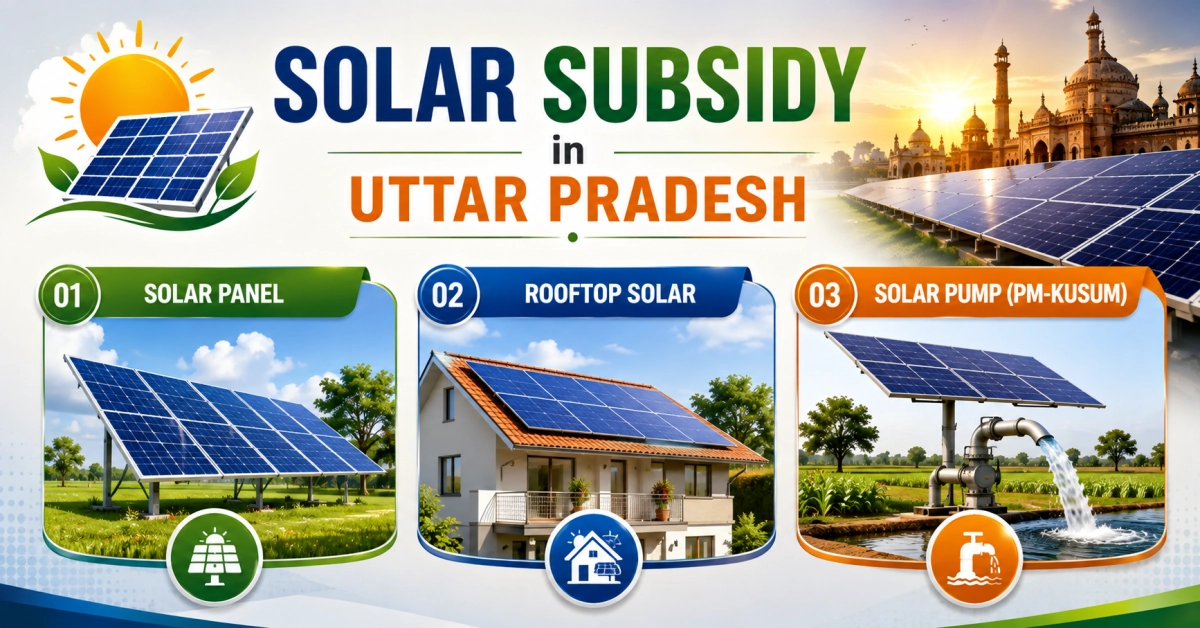
Solar energy is becoming an increasingly practical option for households, farmers and businesses in Uttar Pradesh. Rising electricity costs, improving solar technology and government support have made rooftop solar and agricultural solar projects more accessible.
If you are searching for solar subsidy in UP, it is important to understand that there is not one single subsidy applicable to every type of solar project. The benefit depends on the type of installation, the consumer category and the government scheme under which the project is being implemented.
For residential rooftop solar, the major programme is PM Surya Ghar: Muft Bijli Yojana. The central subsidy is ₹30,000 per kW for the first 2 kW and ₹18,000 for the additional 1 kW, making the maximum central subsidy ₹78,000. Uttar Pradesh has also provided additional state support for eligible residential rooftop systems. UPNEDA’s published material states that the UP state subsidy is ₹15,000 per kW up to a maximum of ₹30,000 per consumer.
For farmers, solar pump support is handled differently. PM-KUSUM covers standalone solar agriculture pumps, solarisation of existing agricultural pumps and other solarisation components. Therefore, the residential rooftop subsidy figures should not be used to calculate a farmer’s solar pump subsidy.
This guide explains the major solar subsidy categories in Uttar Pradesh, who may qualify, how the application process works and what you should check before investing in a solar system.
Important: Government schemes, subsidy amounts, eligibility conditions and implementation procedures can be revised. Always verify the latest applicable guidelines and portal information before making a financial decision.
What Is Solar Subsidy in UP?
A solar subsidy is financial support provided under a government programme to reduce the effective cost of installing an eligible solar energy system. The purpose is to encourage households, farmers and other eligible users to shift towards renewable energy.
However, solar subsidy does not mean that every solar panel purchase automatically receives a government payment.
The applicable benefit can depend on:
- Type of solar installation
- System capacity
- Residential or agricultural use
- Applicable government scheme
- Approved or eligible vendor
- Electricity connection
- Documentation
- Installation and inspection requirements
- Current government guidelines
For example, a residential rooftop solar customer and a farmer installing a solar irrigation pump may both use solar energy, but they may fall under completely different subsidy frameworks.
Solar Subsidy in UP: Quick Overview
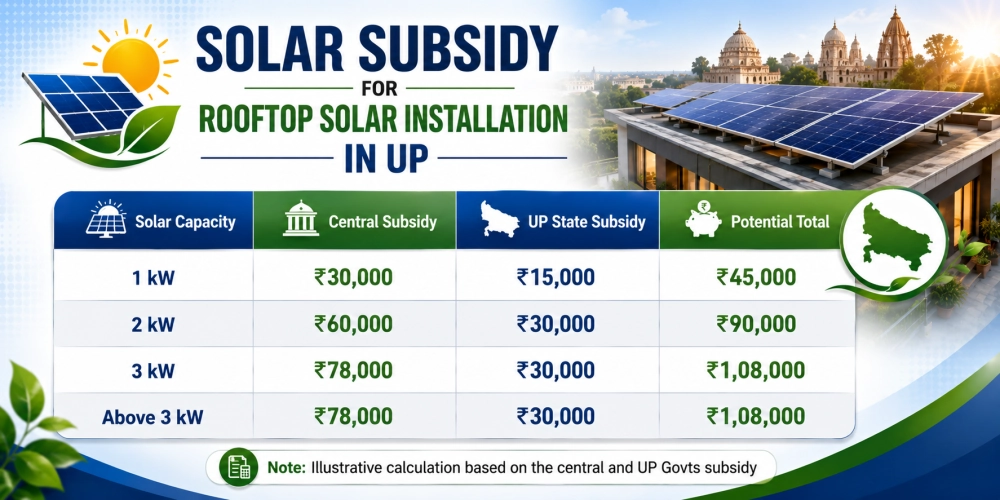
For eligible residential rooftop solar installations, the central subsidy structure under PM Surya Ghar is:
| Solar Capacity | Central Subsidy | UP State Subsidy* | Potential Total |
|---|---|---|---|
| 1 kW | ₹30,000 | ₹15,000 | ₹45,000 |
| 2 kW | ₹60,000 | ₹30,000 | ₹90,000 |
| 3 kW | ₹78,000 | ₹30,000 | ₹1,08,000 |
| Above 3 kW | ₹78,000 | ₹30,000 | ₹1,08,000 |
*The UP state subsidy shown here is based on UPNEDA’s published PM Surya Ghar material and is subject to the applicable eligibility and current implementation rules.
The central component is capped at ₹78,000 for systems of 3 kW and above.
This table should not be used for solar pumps, commercial solar plants or large utility-scale projects.
Solar Panel Subsidy in UP
The solar panel subsidy in UP is commonly used by homeowners who want to reduce the cost of installing solar at their residence. In practice, the subsidy is connected to an eligible rooftop solar installation rather than simply buying individual solar panels from a shop.
For residential consumers, the PM Surya Ghar programme provides central financial assistance for grid-connected rooftop solar systems. The National Portal is used for applications, while installation and verification involve the relevant DISCOM/vendor process.
Who Can Get Solar Panel Subsidy?
Eligibility depends on the current scheme guidelines, but residential rooftop applicants generally need an eligible residential electricity connection and must meet the applicable programme conditions.
UPNEDA’s rooftop solar information states that residential consumers and eligible RWAs can install rooftop systems, with applications processed through the PM Surya Ghar National Portal.
Does Buying Solar Panels Alone Qualify for Subsidy?
Not necessarily.
The subsidy process is associated with an eligible solar rooftop system installed under the applicable programme requirements. Therefore, customers should check the scheme and vendor requirements before purchasing equipment independently.
Rooftop Solar Subsidy in UP
Rooftop solar is one of the most relevant areas for households looking for solar subsidy in UP.
A grid-connected rooftop system normally consists of:
- Solar PV modules
- Solar inverter
- Mounting structure
- DC and AC cables
- Protection equipment
- Metering and grid-connection components, where applicable
- Installation and commissioning
The household can use the electricity generated by the solar system, while surplus generation can be exported to the grid according to the applicable DISCOM arrangement.
UPNEDA notes that rooftop solar can help residential consumers reduce electricity bills, while the state’s solar portal provides information about rooftop feasibility, subsidy and potential savings.
How Much Rooftop Solar Subsidy Is Available?
The central subsidy is:
- ₹30,000 per kW for the first 2 kW
- ₹18,000 for the additional capacity between 2 kW and 3 kW
- Maximum central subsidy of ₹78,000
For Uttar Pradesh, UPNEDA’s published information additionally describes state support of ₹15,000 per kW up to ₹30,000 per consumer.
Therefore, eligible residential consumers may see a combined benefit of up to ₹1,08,000 lakh under the stated central and UP support structure.
Solar System Subsidy in UP
The solar system subsidy in UP can refer to different types of solar installations. A residential rooftop solar system is different from:
- Solar water pump
- Solar irrigation pump
- Solar power plant
- Commercial rooftop solar
- Industrial solar
- Solar farming project
The first question should therefore be: What type of solar system are you planning to install?
If it is a residential grid-connected rooftop system, check PM Surya Ghar and the applicable UP state support.
If it is an agricultural pump, check PM-KUSUM and the current UP implementation process.
If it is a larger solar plant, check the applicable UP solar policy, project category and incentives.
Solar Pump Subsidy in UP
Farmers searching for solar pump subsidy in UP, solar water pump subsidy in UP, or solar submersible pump subsidy in UP should look at agricultural solarisation programmes rather than residential rooftop subsidy.
One of the major programmes is PM-KUSUM — Pradhan Mantri Kisan Urja Suraksha evam Utthaan Mahabhiyaan.
The scheme includes:
- Component A: Decentralised grid-connected renewable energy plants
- Component B: Standalone solar agriculture pumps
- Component C: Solarisation of grid-connected agriculture pumps and feeder-level solarisation.
This makes PM-KUSUM particularly relevant to farmers interested in solar-powered irrigation.
How Much Solar Pump Subsidy Is Available?
There is no single residential-style ₹45,000/₹90,000/₹1.08 lakh table that should be applied to every solar pump.
Under the PM-KUSUM framework, the subsidy structure depends on the relevant component and implementation conditions.
The official PM-KUSUM information for solarisation of existing pumps states that, for states other than the specified special-category states, central and state subsidies can each be 30%, with the farmer contributing the remaining 40%, subject to the applicable benchmark/tender cost.
The exact amount payable by a farmer can therefore depend on the pump, project cost, applicable benchmark/tender cost, scheme component and current state implementation.
Solar Pump Subsidy in UP for Agriculture
Solar pumps can be useful for agricultural irrigation because they use sunlight instead of relying entirely on conventional electricity or diesel. A farmer considering a solar pump should check:
- Whether the farmer qualifies under the current programme.
- Whether the land meets the scheme requirements.
- What pump capacity is permitted.
- Whether the application is for a new standalone solar pump or solarisation of an existing pump.
- What beneficiary contribution is required.
- Which vendor or implementing agency is authorised.
- Which documents are required.
For PM-KUSUM Component A, the official UP PM-KUSUM FAQ identifies individual farmers, groups of farmers, cooperatives, panchayats, FPOs and Water User Associations among potential eligible categories, subject to scheme conditions. It also states a land-location requirement for projects under that component.
Farmers should therefore avoid relying on social-media posts or old subsidy figures and should verify the current application notice before paying any amount.
PM-KUSUM Solar Pump Subsidy in UP
PM-KUSUM is particularly important for agricultural solarisation. The scheme is designed to increase renewable-energy use in agriculture and includes support for standalone solar agriculture pumps and solarisation of existing grid-connected agricultural pumps.
For farmers, the practical process can generally involve:
- Step 1: Identify the Applicable Component: Determine whether the project is related to a standalone solar pump, existing pump solarisation, feeder solarisation or a decentralised solar power project.
- Step 2: Check Current UP Guidelines: Scheme implementation can vary by state and project category.
- Step 3: Check Eligibility: Review land, farmer, pump and electricity-connection requirements.
- Step 4: Submit the Application: Use the designated official application channel for the relevant programme.
- Step 5: Verification and Selection: The application and supporting information may be checked according to the programme process.
- Step 6: Beneficiary Contribution: If applicable, pay the required beneficiary share through the authorised process.
- Step 7: Installation: The selected/authorised agency or vendor installs the solar pump.
- Step 8: Inspection and Commissioning: The system is checked and commissioned according to the applicable requirements.
Solar Plant Subsidy in UP
The solar plant subsidy in UP covers a much broader category than residential rooftop solar.
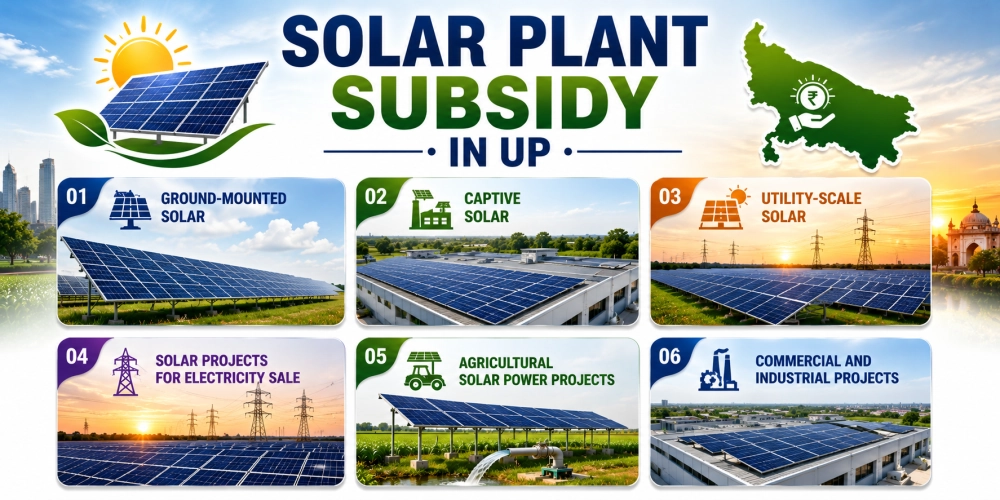
A solar plant may include:
- Ground-mounted solar
- Captive solar
- Utility-scale solar
- Solar projects for electricity sale
- Agricultural solar power projects
- Commercial and industrial projects
For these projects, it is incorrect to simply apply the residential rooftop subsidy table.
Uttar Pradesh’s solar policy provides different incentives for qualifying solar projects. For example, the UP Solar Energy Policy includes provisions relating to land, electricity duty, transmission/wheeling arrangements and support for certain utility-scale solar systems.
Therefore, someone planning a large solar plant should evaluate the project under the applicable UP Solar Energy Policy and current project-specific rules, rather than assuming that a household subsidy applies.
Government Subsidy Scheme for Solar Plant in UP
For large solar projects, government support may take forms other than a direct consumer subsidy.
Depending on the project, incentives can involve:
- State policy incentives
- Electricity-duty benefits
- Land-related support
- Transmission-related provisions
- Wheeling or transmission-charge concessions
- Viability-gap funding in eligible programmes
- Competitive bidding
- Power-purchase arrangements
- Central government programmes
For example, the UP Solar Energy Policy describes support for PM-KUSUM-related projects and other solar power projects, while UPNEDA is identified as the state’s nodal renewable-energy agency.
The key point is that solar plant incentives are project-specific.
How to Get Solar Panel Subsidy in UP
If you are a residential consumer planning rooftop solar, the process should begin with eligibility and scheme verification.
1. Check Your Electricity Connection
Confirm that your electricity connection and consumer category meet the applicable requirements.
2. Estimate Your Solar Requirement
Review your electricity consumption and available roof space.
As a general planning reference, UPNEDA material indicates that a 1 kW rooftop system may need around 10 square metres of shade-free roof area.
3. Apply Through the Applicable Portal
Residential PM Surya Ghar applications are processed through the National Portal.
4. Select an Eligible Vendor
Use the applicable vendor-selection process rather than choosing a supplier solely because of a low price.
5. Complete Installation
The vendor installs the system according to the programme requirements.
6. Complete Verification and Metering
The relevant DISCOM processes the required inspection, metering and commissioning steps.
7. Subsidy Processing
After successful installation and verification, the applicable subsidy/CFA is processed according to the scheme.
MNRE explains that CFA is transferred after successful installation by eligible vendors and verification by the State DISCOMs under the applicable mechanism.
You can also book a free consultation with Saursetu Team for your solar subsidy.
Documents Required for Solar Subsidy in UP
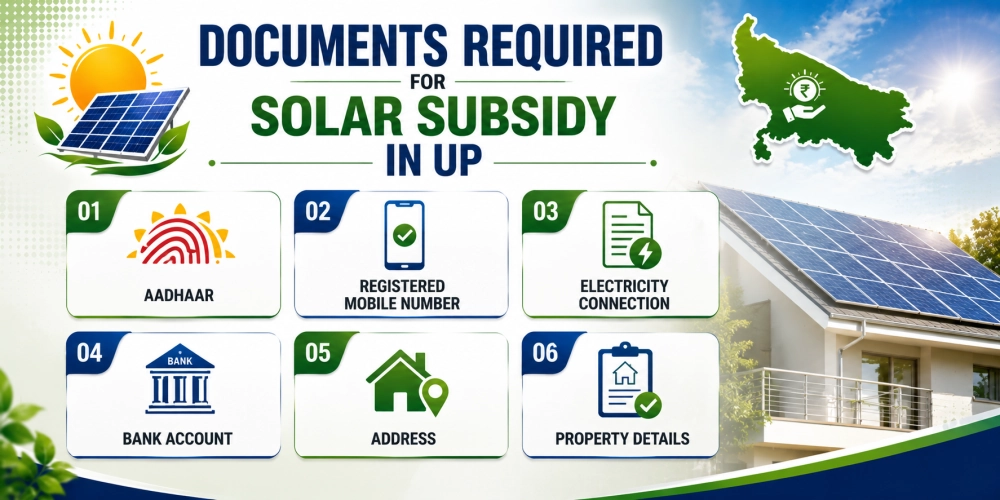
The exact documents depend on the scheme, but residential applicants should be prepared with information such as:
- Aadhaar or other identity information
- Registered mobile number
- Electricity connection details
- Recent electricity bill
- Bank account information
- Address details
- Property/roof-related information, where required
- Vendor and installation documents
- Scheme-specific declarations or forms
Farmers applying under agricultural schemes may additionally need documents related to:
- Agricultural land
- Farmer identity
- Pump
- Electricity connection
- Bank account
- Scheme eligibility
Always check the latest official document list before submitting the application.
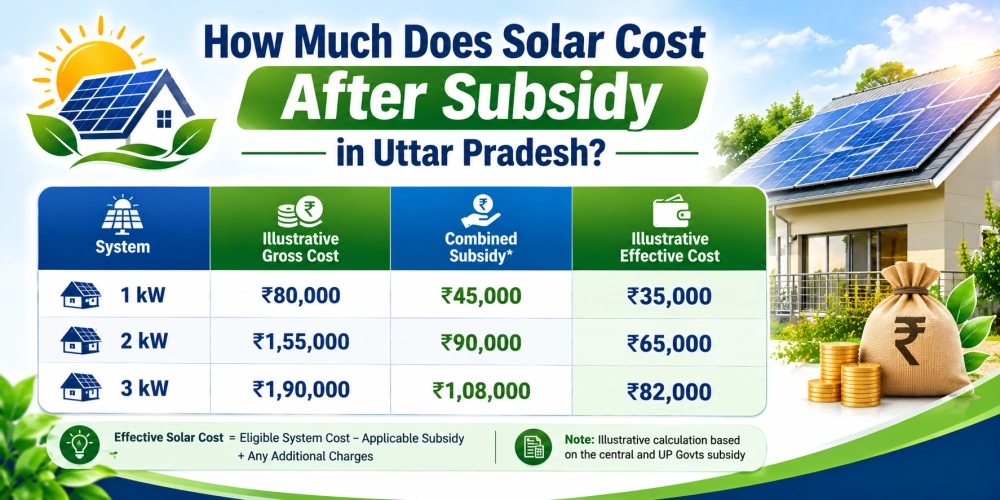
How Much Does Solar Cost After Subsidy in UP?
The final cost depends on the vendor, equipment, system configuration, installation requirements and applicable subsidy.
For illustration, consider the following example:
| System | Illustrative Gross Cost | Combined Subsidy* | Illustrative Effective Cost for You |
|---|---|---|---|
| 1 kW | ₹80,000 | ₹45,000 | ₹35,000 |
| 2 kW | ₹1,55,000 | ₹90,000 | ₹65,000 |
| 3 kW | ₹1,90,000 | ₹1,08,000 | ₹82,000 |
*Illustrative calculation based on the central and UP subsidy figures described above. Actual project prices, eligibility, applicable subsidy and additional work may differ.
The simple formula is: Effective Solar Cost = Eligible System Cost − Applicable Subsidy + Any Additional Charges
Additional expenses can include structural work, electrical upgrades or other site-specific requirements.
1 kVA Solar Panel Price With Government Subsidy in UP
People often search for “1 kVA solar panel price with government subsidy in UP.”
However, kVA and kW are not the same measurement.
- kW generally refers to real power capacity.
- kVA refers to apparent power capacity.
- Solar panels are normally discussed using their watt or kW capacity.
- Inverters are commonly specified in kVA or kW.
Therefore, a 1 kVA inverter should not automatically be treated as a 1 kW solar panel system.
Before calculating subsidy or price, identify:
- Solar panel capacity
- Inverter capacity
- System type
- Residential eligibility
- Installation cost
- Applicable subsidy
- Metering requirements
This prevents customers from comparing two systems that are not technically equivalent.
Solar Panel Subsidy in UP in Hindi
अगर आप उत्तर प्रदेश में सोलर पैनल सब्सिडी लेना चाहते हैं, तो सबसे पहले यह समझना जरूरी है कि सब्सिडी आपके सोलर सिस्टम के प्रकार पर निर्भर करती है।
घरेलू रूफटॉप सोलर के लिए PM Surya Ghar योजना के तहत केंद्रीय सहायता उपलब्ध है। पहले 2 kW तक ₹30,000 प्रति kW और अतिरिक्त 1 kW के लिए ₹18,000 की केंद्रीय सहायता का प्रावधान है। 3 kW या उससे अधिक सिस्टम के लिए अधिकतम केंद्रीय सहायता ₹78,000 है।
उत्तर प्रदेश में पात्र घरेलू उपभोक्ताओं के लिए राज्य स्तर पर अतिरिक्त सहायता भी प्रकाशित की गई है।
वहीं, किसानों के लिए PM-KUSUM के तहत सोलर पंप और कृषि पंप के सोलराइजेशन की अलग व्यवस्था है। इसलिए रूफटॉप सोलर की सब्सिडी और सोलर पंप की सब्सिडी को एक जैसा नहीं मानना चाहिए।
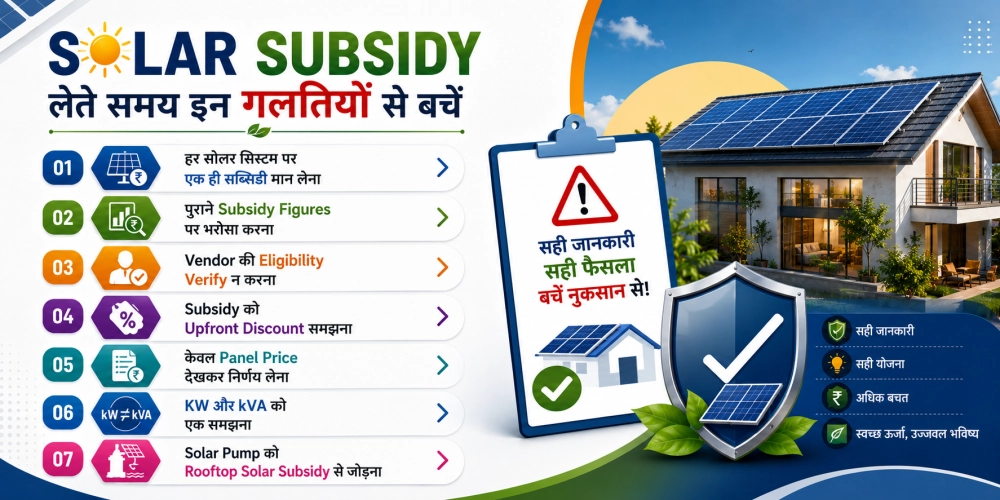
Solar Subsidy लेते समय इन गलतियों से बचें
सोलर सिस्टम खरीदने या सब्सिडी के लिए आवेदन करने से पहले इन सामान्य गलतियों से बचें:
- हर सोलर सिस्टम पर एक ही सब्सिडी मानना: Rooftop solar, solar pump और solar plant के लिए अलग-अलग योजनाएं और नियम लागू होते हैं।
- पुरानी subsidy figures पर भरोसा करना: सरकारी योजनाओं, राशि और पात्रता में बदलाव हो सकते हैं। आवेदन से पहले आधिकारिक पोर्टल पर जानकारी जांचें।
- Vendor की eligibility verify न करना: केवल अधिकृत या empanelled vendor से ही काम कराएं और उसकी मान्यता की पुष्टि करें।
- Subsidy को upfront discount समझना: कई योजनाओं में subsidy installation, inspection और verification के बाद जारी होती है।
- केवल panel price देखकर निर्णय लेना: Inverter, structure, wiring, protection devices, installation और metering charges भी कुल लागत में शामिल हो सकते हैं।
- kW और kVA को समान समझना: kW वास्तविक power capacity, जबकि kVA apparent power capacity दर्शाता है।
- Solar pump को rooftop subsidy से जोड़ना: कृषि पंपों के लिए PM-KUSUM जैसी अलग योजनाएं लागू हो सकती हैं।
Solar Subsidy vs Solar Loan
Subsidy और loan एक ही चीज नहीं हैं।
| Feature | Solar Subsidy | Solar Loan |
|---|---|---|
| Purpose | Eligible project cost कम करना | Installation को finance करना |
| Repayment | Subsidy को सामान्य loan की तरह repay नहीं किया जाता | EMI/repayment होता है |
| Eligibility | Government scheme based | Lender based |
| Amount | Scheme rules के अनुसार | Loan eligibility के अनुसार |
| Availability | Applicable scheme पर निर्भर | Bank/financial institution पर निर्भर |
PM Surya Ghar also has financing provisions. A July 2026 government release said collateral-free loans were being made available through nationalised banks at a concessional rate linked to the repo rate.
This means eligible consumers may have the option of combining government support with financing, subject to current terms and eligibility.
FAQ for Solar Subsidy in UP
1. What is the solar subsidy in UP?
For eligible residential rooftop solar, the central subsidy is ₹30,000/kW for the first 2 kW and ₹18,000 for the additional 1 kW, with the central benefit capped at ₹78,000. UP has also published additional state support for eligible residential consumers up to ₹30,000.
2. How much subsidy is available for a 1 kW solar system in UP?
The central subsidy is ₹30,000. Under the published UP residential support structure, an additional ₹15,000 may apply, making the stated combined benefit ₹45,000 for an eligible 1 kW residential system.
3. How much subsidy is available for a 2 kW solar system?
The central subsidy is ₹60,000. With the published UP state support of ₹30,000, the combined stated benefit can reach ₹90,000 for eligible residential consumers.
4. What is the maximum central rooftop solar subsidy?
The maximum central subsidy for an eligible residential system is ₹78,000.
5. How can I get solar panel subsidy in UP?
Eligible residential consumers can apply through the PM Surya Ghar National Portal and follow the vendor, installation, DISCOM verification and commissioning process.
6. Is solar pump subsidy available for farmers?
Yes, agricultural solar pumps and pump solarisation are covered under PM-KUSUM components, subject to applicable eligibility and implementation rules.
7. Is solar pump subsidy the same as rooftop solar subsidy?
No. Residential rooftop solar and agricultural solar pumps are covered under different programme frameworks and should be calculated separately.
8. What is PM-KUSUM?
PM-KUSUM is a government programme focused on solar energy in agriculture. Its components include decentralised solar power plants, standalone solar agriculture pumps and solarisation of grid-connected agricultural pumps.
9. Is there a government subsidy for solar power plants in UP?
There are various policy incentives and project-specific support mechanisms, but a large solar power plant should not be treated like a residential rooftop system. Applicable UP policies and project conditions must be checked.
10. Can a commercial property claim the residential rooftop subsidy?
The residential PM Surya Ghar CFA is intended for eligible residential consumers. Commercial and industrial projects should be evaluated under the applicable policy and incentive framework.
11. What documents are required?
Documents vary by scheme. Residential applications may require electricity connection information, consumer details and bank information, while agricultural applications may require additional farmer, land and pump-related documents.
12. Can I install more than 3 kW?
Yes, an eligible residential system can be larger than 3 kW, but the central subsidy is capped at ₹78,000 under the stated structure.
Conclusion: Choose the Right Solar Subsidy Scheme
Solar subsidy in Uttar Pradesh can significantly improve the economics of solar adoption, but the correct subsidy depends on what you are installing and who is installing it.
For a homeowner, the first place to look is the PM Surya Ghar rooftop solar programme and the applicable UP state support. The central subsidy can reach ₹78,000, while UPNEDA’s published material describes additional UP support of up to ₹30,000 for eligible residential consumers.
For farmers, the relevant route may be PM-KUSUM, particularly for standalone solar agriculture pumps and solarisation of existing agricultural pumps. The subsidy calculation is different and depends on the applicable component and implementation rules.
For businesses, institutions and solar developers, larger projects should be evaluated under the applicable Uttar Pradesh solar policy and project-specific incentives rather than residential subsidy figures.
Before making an investment, check your eligibility, compare system quotations, understand the applicable subsidy, verify the vendor and confirm the latest government guidelines.
If you are planning solar installation in Uttar Pradesh, SaurSetu can help you understand your solar requirement, estimate the system size and navigate the installation process based on your property and energy needs.
Also Read: Solar Panel Installation Cost in India 2026